Certainty with consequences. Faith without mercy.

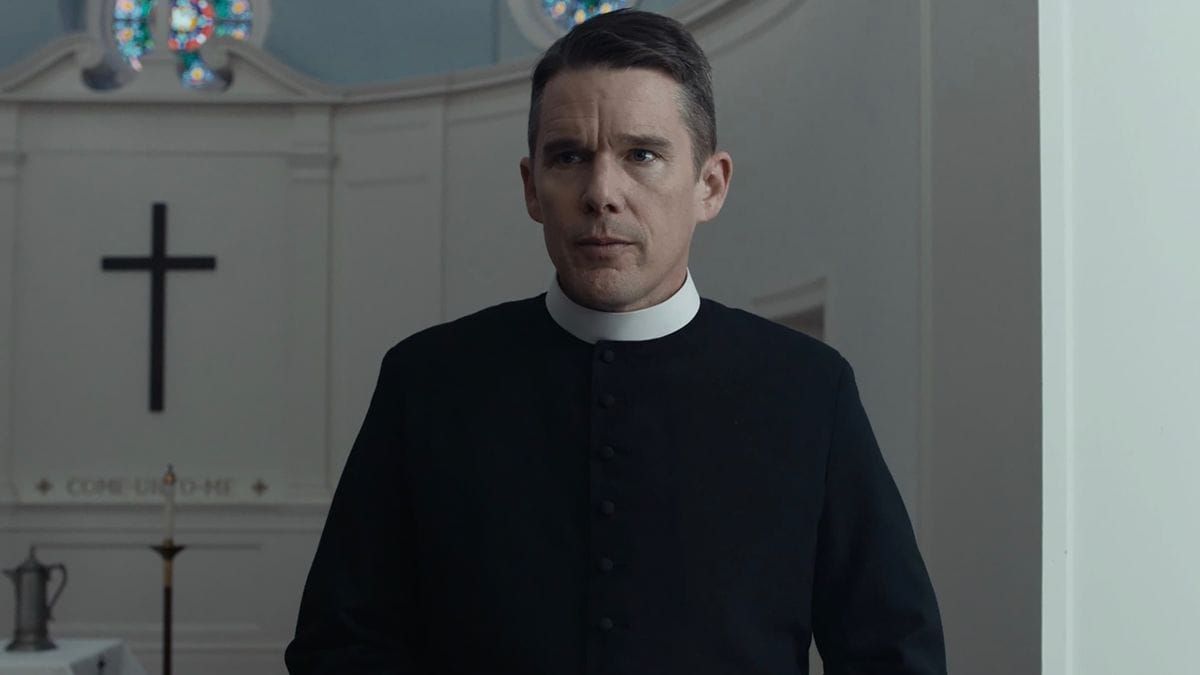
FIRST REFORMED is Paul Schrader at his most severe — a film that doesn’t argue its ideas so much as corner you with them. It’s less a drama than a vigil, stripped of comfort, stripped of ornament, stripped of the illusion that faith is meant to make life easier. Schrader builds the film like a chapel with no heat: spare, rigid, unforgiving. You don’t sit back and watch it. You endure it. Ethan Hawke’s Reverend Ernst Toller is the kind of man cinema rarely lets exist without irony: deeply intelligent, morally serious, and quietly collapsing. Hawke plays him with disciplined restraint, like someone who believes suffering is a form of obedience. Toller doesn’t rage against doubt — he catalogs it. He writes because writing gives pain structure, and structure feels like survival. His isolation isn’t accidental; it’s self-imposed, a penance disguised as vocation.
What makes FIRST REFORMED so devastating is how it fuses spiritual despair with ecological grief. Climate catastrophe isn’t treated as politics or futurism — it’s a crisis of creation itself. If the world is sacred, what does it mean to knowingly poison it? Schrader presents this not as a debate but as a moral wound that never closes. The church’s corporate alliances, its careful language, its avoidance of confrontation all feel like theological malpractice. God doesn’t thunder. God doesn’t intervene. God, if present, watches.
The film’s visual discipline is merciless. The boxy frame traps Toller inside doctrine, history, expectation. Every shot feels like a rule he refuses to break — until the rules start breaking him. Schrader’s stillness isn’t aesthetic minimalism; it’s moral suffocation. When the film finally allows something like transcendence, it’s unstable, frightening, and unresolved. Grace here doesn’t arrive cleanly. It crashes.
Amanda Seyfried’s Mary is often mistaken for softness, but she’s the film’s moral counterweight. She doesn’t theologize pain or aestheticize despair. She listens. She stays. In a story obsessed with martyrdom and legacy, her presence insists on something quieter and more radical: care without ideology. She doesn’t save Toller. She reminds him that being alive is not a theoretical exercise.
The ending of FIRST REFORMED is divisive because it refuses the safety of interpretation. Is it redemption? Delusion? A last human interruption before self-annihilation? Schrader offers no clarifying cut, no moral footnote. The moment hangs there, unresolved, because certainty is the lie the film has been dismantling from the start.
What lingers after FIRST REFORMED isn’t inspiration — it’s unease. This is a film about what happens when moral clarity exists without mercy, when conviction hardens into something indistinguishable from violence. It asks whether faith can survive a world that no longer pretends to be innocent — and whether survival is even the goal.
This isn’t a movie that comforts. It’s a reckoning whispered by a man who stayed too long with his questions and found they wouldn’t let him go.