Faith, vodka, and the machinery of power.

LEVIATHAN is the kind of cinema that understands the weight of the earth and the cold indifference of the sea. It is a story about the crushing intersection of power, religion, and the individual — where the law is not a shield, but a weapon used by those who already hold everything.
Andrey Zvyagintsev isn’t interested in heroic stands or cinematic justice. He’s interested in the slow, bureaucratic grinding of a human life, wrapping these bleak themes in haunting, widescreen imagery that hides a howl of bottled-up rage against a system designed to break the human spirit.
At the center of the story is Kolya, a hot-tempered mechanic trying to hold onto the home his family has inhabited for generations. His struggle against a corrupt local mayor isn’t just a legal battle; it is a slow-motion car crash of a man fighting a monster too large to be slain.
Zvyagintsev frames this as a study in power's true nature—how the alliance between the state and the church creates a suffocating canopy that leaves the common man with nowhere to turn.
Aleksey Serebryakov is extraordinary here, delivering a performance built on raw nerves and vodka-soaked desperation. His Kolya carries a kind of internal static—proud, stubborn, and increasingly hollowed out. You see the pride in his eyes slowly erode into a hollow stare as the world he built is dismantled piece by piece.
Beside him, Elena Lyadova provides a quiet, tragic counterpoint, her own internal displacement adding a layer of domestic fragility to the political storm.
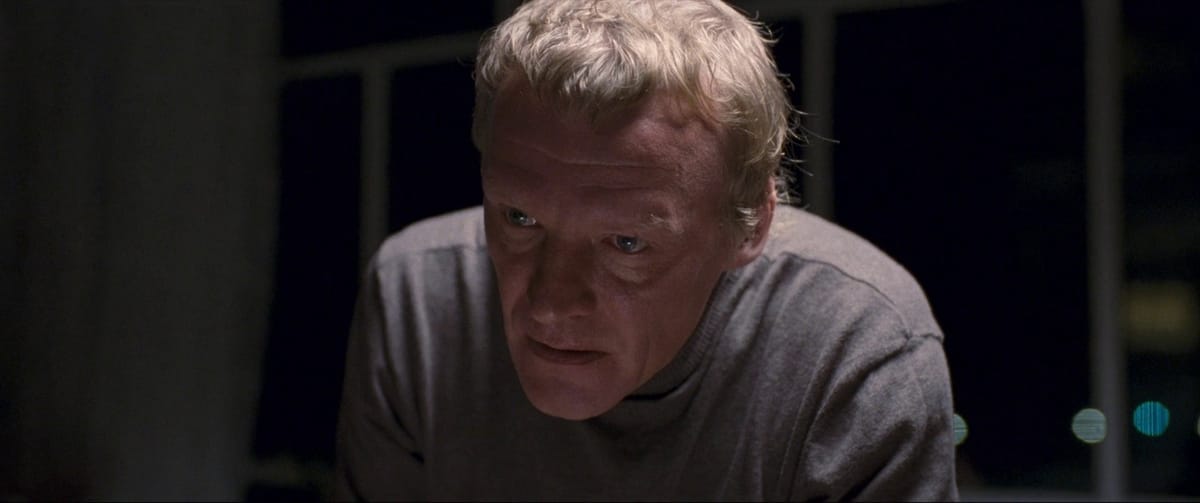
Roman Madyanov is chillingly effective as the Mayor, Vadim. He doesn't play the villain as a caricature, but as a banal, bloated creature of habit who views his corruption as a birthright. His scenes highlight the grotesque reality of power that has gone unchecked for so long it has forgotten how to be anything else. He is the human face of a machine that doesn't even bother to hate the people it crushes.
The presence of the Orthodox Church provides the film’s most stinging critique. The local Bishop doesn't offer spiritual sanctuary; instead, he offers divine justification for cruelty. The film understands that when the authorities and the heavens are in agreement, the rules of the game are decided before the individual even steps onto the board. It is a profound look at how faith can be weaponized to silence the victim.
Visually, the film is a triumph of atmosphere over artifice. Mikhail Krichman captures the Russian North as a place of skeletal beauty, where the recurring image of a bleached whale skeleton serves as a grim memento mori. The landscape is vast, gray, and magnificent, making the human characters look like ants crawling over an ancient, unfeeling terrain that remembers more than the people living on it.
The pacing reflects the inevitability of the tragedy, moving with a deliberate, tectonic weight. There’s no cathartic confrontation designed to cleanse the room; instead, the tension simmers in long, unbroken takes. Every legal setback and personal betrayal feels like another stone being added to a drowning man's pockets, proving that institutional injustice doesn't happen in a single blow, but in a series of signatures and stamps.
What makes LEVIATHAN resonate most is its refusal to give the audience emotional shortcuts. It stares directly into the sun of institutional injustice without blinking, suggesting that while the individual may be righteous, the machine is immortal. The "Leviathan" is many things: the state, the church, the sea, and the biblical monster that Job could not hook. It represents a scale of power that renders human effort almost invisible.
By the final act, the film transcends its setting to become a universal parable about the fragility of modern life. It asks what remains of a person when their home, their family, and their dignity are stripped away. The answer it provides is silence—a vast, echoing silence that suggests the most devastating monsters don't hide in the dark, but sit comfortably behind a desk in broad daylight.
LEVIATHAN isn’t trying to offer a message of hope or a roadmap for reform. It doesn't need to. What it offers instead is a profound, cinematic autopsy of a broken society. It is a film of immense scale and intimate sorrow that reminds us that some battles are lost not because of a lack of courage, but because of the sheer weight of the world.