Infamy is self-authored.

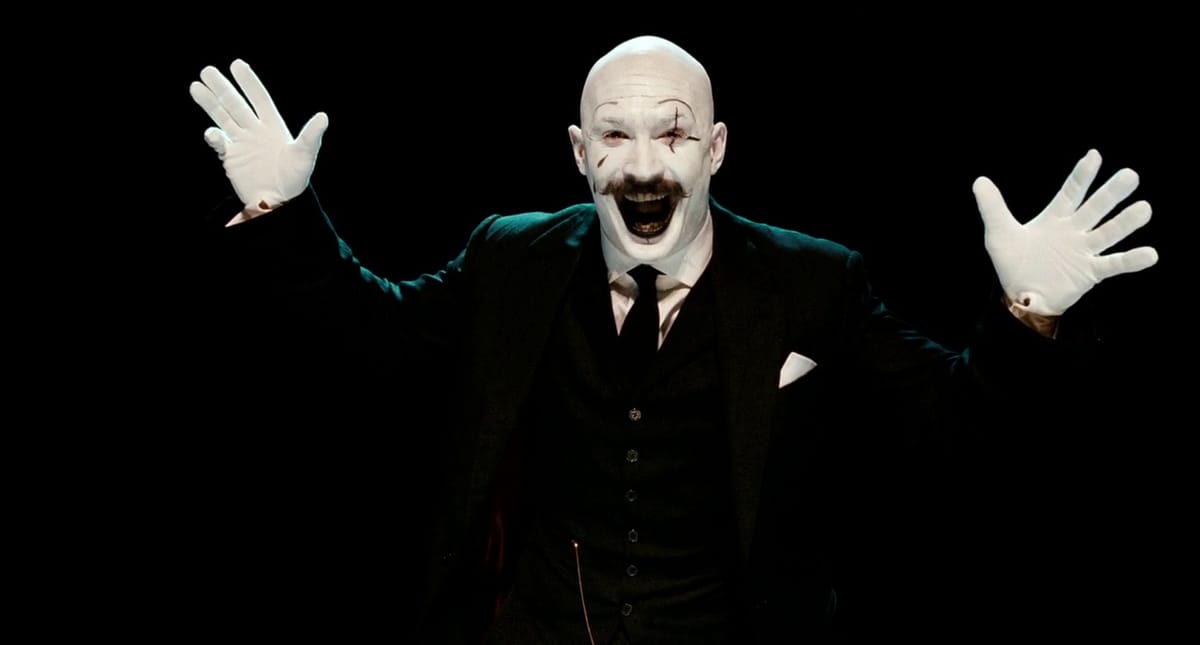
BRONSON is Nicolas Winding Refn’s attempt to strip notoriety down to its theatrical core — and what remains is not a misunderstood martyr or a conventional monster, but a man who turned violence into performance and prison into stage. This isn’t a redemption story. It’s an origin story of spectacle — the making of a persona so large it devours the person underneath.
Refn begins where most biopics hesitate: inside the mythology rather than outside it. Michael Peterson doesn’t become Charles Bronson because of ideology, injustice, or tragic necessity. He becomes him because he wants to be seen. From the outset, the film makes its thesis clear — this is not about crime as survival. It’s about identity as construction. Peterson isn’t fighting the system; he’s auditioning for immortality.
Tom Hardy’s performance is the film’s detonator. He doesn’t play Bronson with realism. He plays him with operatic bravado — preening, grinning, flexing, narrating his own legend to an imagined audience seated just beyond the fourth wall. Hardy understands that the man is addicted not simply to violence, but to reaction. His Bronson is charismatic and grotesque in equal measure — a bodybuilder Shakespearean clown pounding against the walls of his own confinement.
That theatricality is essential, because BRONSON is not interested in the sociology of incarceration. It’s interested in performance under confinement. The prison becomes less a correctional facility and more a proscenium arch. Solitary confinement is lit like a spotlight. Beatings are choreographed like dance numbers. Even brutality feels rehearsed. Refn frames violence as spectacle — not to glorify it, but to expose its absurdity.
The film’s structure mirrors Bronson’s psychology. Reality bleeds into fantasy. Memory becomes unreliable. The narrative fractures into stylized vignettes — monologues, tableaux, bursts of classical music over savage fights. Refn refuses naturalism. He doesn’t want you to believe you are watching truth. He wants you to recognize myth being assembled in real time.
What makes the film unsettling is its refusal to provide moral footing. Bronson is not contextualized through trauma in the comforting way many biopics insist upon. There are no tidy psychological diagnoses, no redemptive backstories offered as explanation. He fights because he enjoys it. He escalates because escalation gives him narrative. The system responds with more confinement, which only feeds the persona further. It becomes a feedback loop: punishment as publicity.
Visually, BRONSON is loud and deliberate. Red curtains, white walls splattered with paint and blood, bare cells transformed into abstract canvases. Refn understands that space is psychological. The more stripped-down the environment, the more exaggerated Bronson becomes. Confinement doesn’t shrink him; it distills him.
Hardy’s physical transformation is impressive, but it’s the performative nuance that lingers. The soft-spoken charm before the eruption. The self-awareness flickering beneath the bravado. In quieter moments, there’s a suggestion — not of regret — but of emptiness. The applause he craves never truly arrives. The legend grows. The man remains locked inside it.
What’s most striking is how deliberately the film avoids redemption. There is no grand reckoning. No lesson learned. Bronson doesn’t emerge wiser; he emerges more defined. By the end, the persona feels complete — not because it has triumphed, but because it has fully consumed its creator.
Refn’s greatest achievement may be his refusal to explain. He neither condemns nor excuses. He presents. He stylizes. He allows the audience to confront the uncomfortable truth that notoriety can be a form of self-creation — and that some people would rather be infamous than invisible.
BRONSON is a biographical film stripped of biography. It doesn’t humanize a criminal in order to forgive him. It examines how spectacle becomes identity, how confinement becomes theatre, and how violence can be wielded as autobiography.
A lurid, confrontational, darkly comic character study — one that understands the most dangerous prison isn’t concrete and steel, but the persona you build and refuse to leave.