Manhunts, myths, and mistakes.
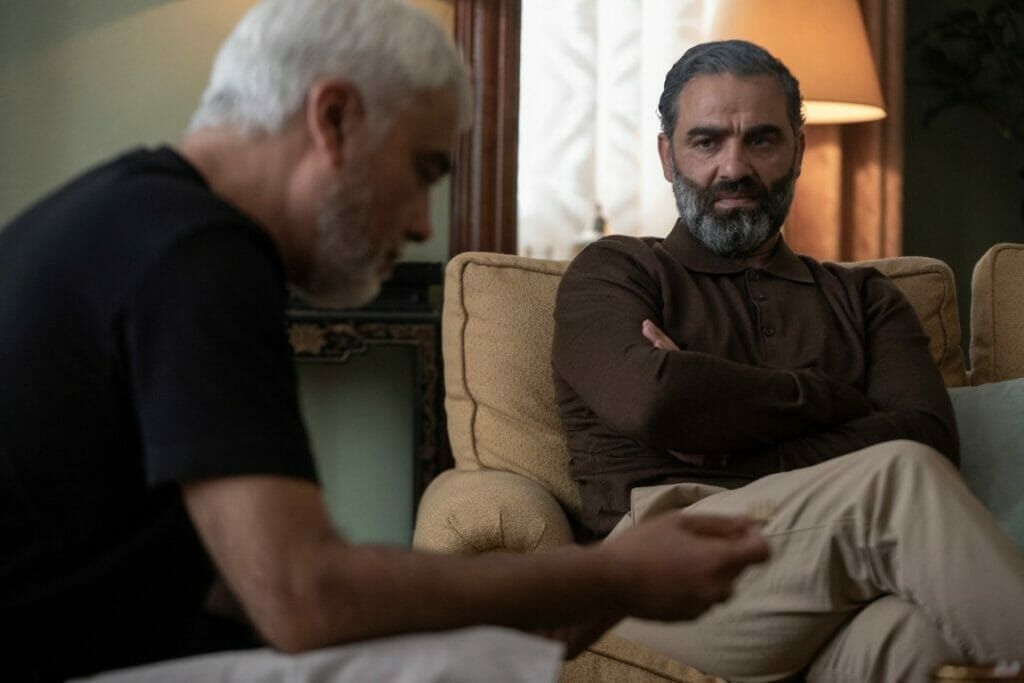
GHOSTS OF BEIRUT is a geopolitical thriller wrapped in documentary skin, a series that blurs biography with espionage reconstruction until the whole thing feels like a haunted dossier. It’s stylish, cerebral, and uncomfortably intimate — a show obsessed not with firefights or bravado, but with the slow, invisible machinery of terror and counterterror. The result is a narrative that unfolds like a classified file being pried open one redacted line at a time.
At its center is Imad Mughniyeh, played with chilling restraint by Amir Khoury. He doesn’t snarl, boast, or grandstand. He moves like a shadow that became a person — an almost mythic figure whose power lies in invisibility and discipline. Khoury’s performance is terrifying precisely because it’s quiet. He plays Mughniyeh not as a monster but as a man who has convinced himself he is a necessary weapon. The horror emerges from that calm.
Opposite him are the CIA and Mossad officers trying — and often failing — to predict, infiltrate, and interpret the shifting logic of Hezbollah’s most elusive operative. Dermot Mulroney, Navid Negahban, Iddo Goldberg, and Maya Sarsour anchor the intelligence side of the story with performances that feel human rather than heroic. They’re tired, morally bruised, depleted by the sheer volatility of the 1980s–2000s Middle East. The show refuses to paint them as saviors; it paints them as people caught in systems too large, too violent, too contradictory to control.
Stylistically, GHOSTS OF BEIRUT oscillates between dramatization and documentary — actors intertwined with expert interviews, intelligence veterans narrating alongside cinematic reenactments. It’s an unusual hybrid, one that pushes the viewer to constantly question the line between reconstructed truth and the unknowable space where real history hides. The structure mirrors the subject: Mughniyeh was a man defined by what could not be proven, what could not be seen, what existed only in faint signals and aftermaths.
The series excels in atmosphere. Beirut is shot not as a backdrop but as a wounded city — vibrant, weary, carved by war and resilience. Every street feels like it has its own memory. Explosions aren’t spectacle; they’re trauma loops. Meetings take place in dim corners where paranoia has replaced architecture. You feel the weight of decades stacked on top of one another.
Most importantly, the show refuses propaganda. It doesn’t hand out moral clarity. Hezbollah is not romanticized. The CIA is not absolved. Israel is not sanctified. The Middle East conflict is treated like a living wound: layered, generational, inherited. The series shows how violence metastasizes — how ideology, retaliation, grief, colonization, foreign intervention, and ambition twist together until no decision is clean, no truth uncontested.
What emerges is a portrait of a man whose ghost still shapes geopolitics. Mughniyeh’s evolution — from teenage street fighter to global orchestrator — is mapped with alarming plausibility. Yet the show always keeps a distance, reminding us that mythmaking is as much a weapon as any explosive.
The final episodes are suffocating. The hunt narrows. The pressure builds. Every agency second-guesses every ally. The intelligence world becomes a hall of mirrors. When the end finally comes, it lands not with triumph but with fatigue — the realization that in these shadow wars, eliminating one ghost simply clears space for the next.
GHOSTS OF BEIRUT is bleak, riveting, unflinching TV: a political autopsy, a character study, and a reminder that the most consequential conflicts rarely unfold on battlefields. They unfold in whispers, in secrets, in the decisions made in rooms where the lights stay low.
It’s not a series you enjoy. It’s one you absorb — like classified information you were never meant to read.