White smoke, dark intentions.

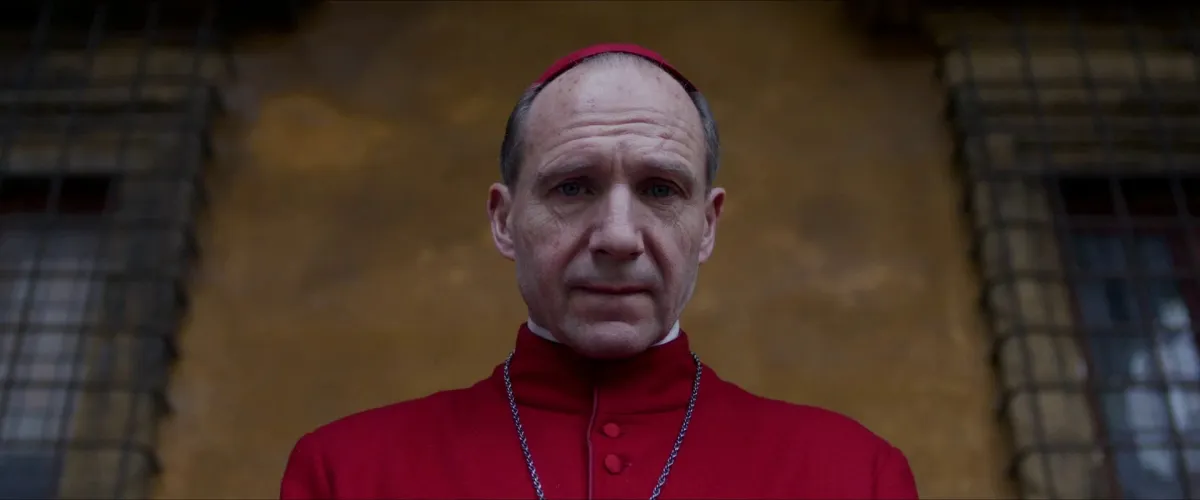
CONCLAVE isn’t really about succession. Not in the spiritual sense the film initially invites. It’s about control—who gets to define continuity, who gets to narrate legitimacy, and how power disguises itself as inevitability when it’s under threat. The election of a pope becomes less a sacred process than a managed transition, one that depends on the careful containment of doubt. That governing idea runs quietly but persistently through the film. What looks like ritual is revealed, piece by piece, as choreography. Not empty, not cynical in a blunt way, but structured. Decisions aren’t guided by revelation so much as shaped by proximity, influence, and the slow accumulation of pressure. The film keeps asking the same question from different angles: if belief is the foundation, why does everything feel negotiated? Form carries that tension more effectively than the script does. The pacing is deliberate to the point of friction—scenes don’t resolve so much as taper off, conversations ending mid-thought or shifting before they fully land. It creates a sense of suspended movement, as if the film itself is reluctant to commit. Editing follows that logic. Cuts aren’t used to accelerate but to withhold, to interrupt clarity just as it begins to form. Visually, the film leans into control. Symmetry, stillness, corridors that feel less like pathways than funnels. The camera doesn’t wander; it positions. Even moments of supposed intimacy are framed with a kind of institutional distance, as if no one is ever fully outside the system they’re operating within. It’s effective, but also limiting. The Vatican becomes less a lived space than a regulated one—experienced, but never quite inhabited. Sound design follows a similar restraint. Silence isn’t emptiness here; it’s pressure. Conversations feel buffered, voices contained, as though the walls themselves are part of the process. When music does enter, it doesn’t swell so much as underline, reinforcing mood rather than complicating it. The film rarely risks dissonance, and that choice keeps it coherent, but also slightly closed off. Performance is where the film finds its instability. Ralph Fiennes doesn’t play authority—he plays erosion. His Cardinal Lawrence feels like someone performing certainty while internally negotiating its absence. There’s a hesitation in his rhythm, a slight delay in reaction, that suggests thought arriving too late to be useful. It’s a controlled performance, but not a confident one, and that distinction matters. Stanley Tucci, by contrast, brings fluency. His presence is smoother, more legible, someone who understands the system well enough to move within it without friction. John Lithgow introduces a different energy again—less about belief, more about leverage. None of these performances announce themselves. They adjust the film from within, shifting tone rather than dominating it. Where the film becomes more uncertain is in how far it’s willing to follow its own implications. It gestures toward critique—toward secrecy, toward institutional preservation—but stops short of fully interrogating them. The system is exposed, but not destabilized. The film observes power closely, but rarely pressures it. That restraint can read as nuance, but it also feels like a boundary the film won’t cross. In context, that hesitation is telling. This is a film arriving at a moment when institutions—religious, political, cultural—are under sustained scrutiny. Yet CONCLAVE doesn’t position itself as confrontation. It’s closer to examination, but even that feels moderated. It’s interested in how systems function under strain, not in what it would mean for them to fail. What lingers, then, isn’t revelation but pattern. The sense that nothing here resolves because nothing here is meant to. Outcomes don’t disrupt structure; they reaffirm it in slightly altered form. The film understands that continuity is its subject, but it treats that understanding as an endpoint rather than a challenge. So the judgment sits in that space. CONCLAVE is controlled, intelligent, and attentive to the mechanics of power, especially in how it renders them through performance and form. But it’s also cautious—more willing to observe than to confront. It clarifies how the system works. It stops short of asking whether that system can, or should, be undone.