Learning to be hungry.

Some films earn five stars through precision, others through ambition, and a rare few simply make resistance feel pointless, which is exactly where TONY finds itself: funny, warm, unruly, emotionally intelligent, and so completely comfortable inside its own personality that trying to pick apart its pleasures almost feels counterproductive.
At its heart, TONY is a film about people — their absurdities, contradictions, affections, embarrassments, ambitions, and the strange little disasters that emerge whenever those people are forced into the same orbit. It never seems desperate to manufacture charm, nor does it announce its eccentricities or polish its characters until every rough edge becomes conveniently lovable. The humour comes from behaviour, as people misunderstand each other, overreact, say the wrong thing at exactly the wrong moment, and stumble into situations that become progressively more ridiculous because nobody involved possesses the good sense to stop.
Underneath all that chaos, however, is enormous tenderness, and that balance becomes the film’s greatest strength. Comedy and sincerity aren’t separated into alternating modes; they coexist, allowing a ridiculous moment to become unexpectedly moving without sacrificing its humour, while something emotionally vulnerable can still contain the possibility of a perfectly timed joke. TONY understands that real affection often looks ridiculous from the outside, and it embraces that contradiction rather than attempting to resolve it.
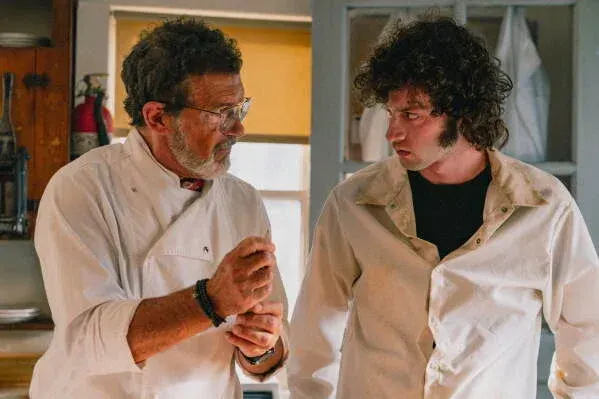
Dominic Sessa is tremendous as the nineteen-year-old Anthony Bourdain, resisting the obvious temptation to impersonate the familiar television personality and instead constructing someone recognisably unfinished. His Tony is intelligent enough to know that he is intelligent, arrogant enough to make sure everyone else knows it too, and insecure enough for that arrogance to gradually reveal itself as armour, with Sessa moving between literary pretension, adolescent bravado, awkwardness, anger and genuine curiosity without allowing any single quality to consume the character.
It is a particularly difficult balancing act because Tony can be a liar, a snob and an asshole, yet Sessa never begs for sympathy or sands those qualities down in pursuit of easy likability. Instead, he locates the restless young man underneath them who desperately wants his life to mean something before he has actually accumulated enough experience to understand what meaning looks like, giving us glimpses of the man Bourdain will eventually become without turning every gesture into an obnoxious piece of biographical foreshadowing.
Antonio Banderas is just as good as the unnamed Chef, and his wonderfully contained performance provides exactly the counterweight Sessa needs. Where Tony enters rooms overflowing with nervous energy, Chef rarely needs to raise his voice or advertise his authority, with Banderas finding enormous character in stillness, concentration and the simple seriousness with which this man approaches his work. His mentorship never feels like the mechanically inspirational relationship a lesser biopic might have constructed, because Chef is not standing around waiting to dispense conveniently prophetic life lessons to the future Anthony Bourdain; he has his own history, disappointments and abandoned ambitions, while Banderas allows those details to sit quietly underneath a man who has found dignity in doing something well.
That relationship gives TONY much of its emotional backbone, because Sessa and Banderas are effectively playing two men at opposite stages of the same question. Tony is obsessed with what he might eventually become, while Chef has already discovered that becoming something impressive and finding something meaningful are not necessarily the same thing, leaving their scenes together with a tenderness that never needs to announce itself. Banderas makes Chef’s authority feel earned rather than imposed, while Sessa gradually changes the way Tony listens to him, allowing mentorship to emerge through behaviour rather than speeches.
Leo Woodall provides a fascinating third point in that masculine education as Sal, whose charisma offers Tony an entirely different model of adulthood. Sal possesses the swagger, recklessness and apparent freedom that Tony initially finds irresistible, and Woodall understands that the character has to be genuinely magnetic for that attraction to make sense rather than merely functioning as an obvious warning sign. His performance gives the film some of its loosest and most dangerous energy, but there is enough vulnerability beneath the bravado to prevent Sal from becoming a stock bad influence, particularly as Tony begins discovering that the men he admires are considerably more complicated than the identities they perform.
Emilia Jones has the less flamboyant task as Nancy, the romantic fixation who initially draws Tony toward Provincetown, but she wisely refuses to play the character as some glowing prize waiting at the end of his adolescent pursuit. Her presence exposes how much of Tony’s supposed confidence depends upon stories he has already written in his own head, while Jones gives Nancy enough independence and resistance to puncture his romantic self-mythologising whenever reality inconveniently refuses to cooperate.
Dagmara Domińczyk similarly makes a strong impression as Gladys Bourdain, with her intelligence and exacting judgement immediately suggesting where Tony acquired both his verbal sharpness and the critical voice he so readily turns against himself, while Stavros Halkias fits beautifully into the restaurant ensemble, embodying precisely the kind of dishevelled kitchen personality that makes this world feel inhabited rather than populated by supporting characters waiting for Tony to arrive.
That ensemble quality matters enormously, because the kitchen is not presented merely as the place where Anthony Bourdain learns to cook; it becomes the first environment where his fascination with people, labour, appetite, excess and the strange social ecosystem surrounding food begins to make sense. The performances collectively sell that ecosystem, giving Tony a collection of personalities to observe long before he possesses the maturity to realise that observing people will eventually become one of the defining talents of his life.
Visually, that same affection translates into filmmaking that feels attentive without becoming self-conscious, with a camera that observes rather than advertises and compositions that consistently serve character. The editing possesses an equally sharp understanding of rhythm, knowing when to linger on a reaction, when to allow awkwardness another precious second to breathe, and when cutting slightly earlier will make something infinitely funnier. Comedy lives or dies on timing, and TONY understands the mechanics of timing without ever making those mechanics visible.
The film also moves beautifully without ever feeling hurried, allowing scenes to accumulate rather than simply advancing the plot from one mandatory destination to another. Conversations alter relationships by fractions, small gestures become important retrospectively, comedy establishes character, character creates emotional investment, and that investment makes the comedy even funnier because these people gradually stop feeling like mechanisms inside a screenplay and become people whose company you genuinely enjoy.
Plenty of films confuse likability with relentless pleasantness, whereas TONY understands that warmth needs friction. Its characters can annoy each other, disappoint each other, misunderstand each other, embarrass themselves, and occasionally behave like complete idiots while remaining connected by something stronger than whatever temporary stupidity currently occupies the room. There is generosity in that worldview without naïveté, because the film knows perfectly well that people can be exhausting while refusing to believe that exhaustion makes them disposable.
That generosity is also why the emotional moments land so cleanly, because TONY never suddenly transforms into a different film whenever sincerity enters the room. The sincerity has been there all along, embedded within the jokes, awkwardness, chaos, mistakes, frustrations and tiny acts of kindness that gradually accumulate into something unexpectedly moving. Humour never functions as armour covering the film’s heart; instead, it becomes one of the ways that heart expresses itself.
More importantly, TONY understands the danger inherent in making a film about Anthony Bourdain, particularly when the audience already knows considerably more about the trajectory of his life than the nineteen-year-old onscreen possibly could. The film could have transformed every youthful insecurity into an omen and every moment of happiness into something retrospectively tragic, but doing so would reduce a human life to its ending. Instead, TONY allows this version of Bourdain to exist in the present tense, still uncertain, obnoxious, curious, hungry, romantic, impulsive and completely unaware that anyone will one day consider these formative experiences worth making a film about.
That choice gives the story an unusual freedom, because it is less interested in explaining Anthony Bourdain than in observing the circumstances that helped awaken him. Food matters, obviously, but people matter more, and the kitchen becomes fascinating precisely because it combines the two. It is loud, hierarchical, multicultural, profane, exhausting and communal, filled with personalities whose lives Tony would never encounter if he remained safely within the boundaries of his own privileged upbringing. Long before travelling the world became his profession, curiosity about the people inhabiting it had to begin somewhere, and TONY finds something wonderfully convincing in suggesting that the appetite came before the vocabulary.
By the time the film reaches its conclusion, what remains isn’t merely a particular gag or dramatic revelation but the sensation of having spent time among people whose company has become strangely indispensable. TONY doesn’t need grand declarations to justify that attachment, because it builds affection patiently through one interaction, one laugh, one mistake, one embarrassment, one meal and one small act of tenderness at a time.
TONY is an extraordinary film because it makes being alive look ridiculous, exhausting, tender, embarrassing, unpredictable and completely worth the trouble, wrapping all of those contradictions into a film that never sacrifices entertainment for meaning or meaning for entertainment. It is joyful without becoming hollow, sentimental without becoming manipulative, hilarious without becoming disposable, and humane without pretending humanity is anything other than an enormous, beautiful mess.