Publishing executives love this one weird trick.

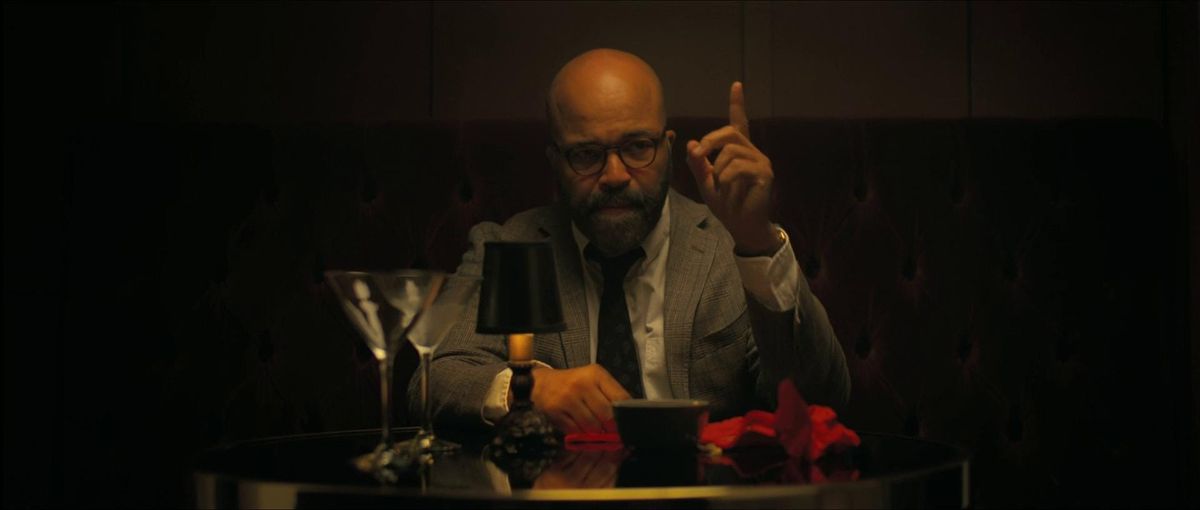
Cord Jefferson's AMERICAN FICTION is one of those rare films that made me howl with laughter while simultaneously leaving me scratching my head at the sheer absurdity of what I was witnessing. Adapted from Percival Everett's 2001 novel ERASURE, Jefferson's feature directorial debut is a wonderfully intelligent satire that examines racial representation, artistic integrity, and the publishing industry's rather peculiar understanding of authenticity. Beneath its outrageous premise lies a surprisingly touching family drama, supported by an exceptional ensemble and a magnificent leading performance from Jeffrey Wright.
What makes AMERICAN FICTION particularly effective is its ability to expose the contradictions of an industry that claims to celebrate diversity while remaining remarkably selective about the stories it considers worthy of attention. Jefferson approaches this subject with considerable wit, questioning why certain depictions of Black American life receive disproportionate commercial recognition while narratives exploring different experiences are frequently overlooked. The resulting satire is frequently hilarious, although its underlying observations are sufficiently plausible to make the laughter occasionally uncomfortable.
Jeffrey Wright portrays Thelonious "Monk" Ellison, an accomplished novelist and university professor whose professional frustrations have left him increasingly disillusioned with the literary establishment. Monk is intelligent, articulate, and extraordinarily difficult to please, possessing an almost supernatural ability to identify the intellectual shortcomings of everyone around him. Unfortunately, his considerable intelligence is accompanied by an equally impressive capacity for arrogance, making him a protagonist whose observations are frequently perceptive even when his behaviour becomes thoroughly exasperating.
Monk's dissatisfaction stems largely from the publishing industry's apparent obsession with particular representations of Black American identity, especially narratives emphasizing poverty, violence, and social deprivation. His own literary interests extend well beyond these subjects, yet publishers appear considerably less enthusiastic about his work than about novels that conform to familiar cultural expectations. His frustration is understandable, particularly when an industry supposedly committed to representation demonstrates remarkably little interest in recognizing the diversity of experiences within the communities it claims to champion.
Matters become considerably more ridiculous when Monk encounters WE'S LIVES IN DA GHETTO, a commercially successful novel by Sintara Golden, portrayed by Issa Rae. Its sensationalized depiction of Black hardship represents everything he has come to resent about contemporary publishing, particularly the assumption that certain experiences constitute more authentic expressions of Black identity than others. His contempt for the novel eventually inspires him to produce an intentionally outrageous parody of the very literary conventions he considers intellectually bankrupt.
Writing under the pseudonym Stagg R. Leigh, Monk constructs a manuscript designed to expose the absurdity of the publishing industry's expectations, exaggerating familiar stereotypes to such an extent that he assumes nobody could possibly mistake his work for serious literature. Unfortunately for Monk, the publishing establishment responds with overwhelming enthusiasm, interpreting his deliberately ridiculous creation as an authentic and groundbreaking contribution to American letters. The resulting misunderstanding becomes increasingly hilarious as the industry celebrates precisely the qualities Monk intended to ridicule.
I found myself howling with laughter throughout these developments, particularly as Monk's increasingly desperate attempts to expose the ridiculousness of his creation merely strengthen the industry's conviction that it has discovered an extraordinary literary talent. There is something profoundly amusing about watching an accomplished novelist become commercially successful through a manuscript he considers an insult to the intelligence of its intended audience. The more seriously the publishers take his work, the more absurd the situation becomes, leaving Monk understandably bewildered by the enthusiasm surrounding his supposed achievement.
What makes these sequences particularly effective is that Jefferson does not rely exclusively upon exaggerated caricatures of unintelligent publishing executives. The individuals who embrace Monk's manuscript genuinely appear to believe they are supporting an important cultural voice, even as their enthusiasm exposes the limitations of their understanding. Their behaviour is deeply patronizing precisely because they remain oblivious to the assumptions informing their judgments, transforming an act of literary mockery into a supposedly profound statement about Black American experience.
Jefferson's screenplay is particularly perceptive in distinguishing between the legitimate depiction of social hardship and the commercial exploitation of narratives that reinforce familiar stereotypes. AMERICAN FICTION does not suggest that literature addressing racism, poverty, violence, or systemic inequality is inherently unworthy of artistic consideration, particularly when such experiences remain important aspects of contemporary society. Instead, the film questions why these narratives are so frequently treated as definitive expressions of Black identity, especially when alternative perspectives struggle to attract comparable institutional recognition.
This distinction gives the satire considerable intellectual substance beyond its immediate comedic appeal, allowing Jefferson to examine the relationship between cultural authenticity and commercial expectations without diminishing the significance of genuine social injustices. The problem is not that stories depicting hardship exist, but that publishers sometimes appear more interested in their marketability than in recognizing the diversity of experiences within Black communities. Consequently, the film's criticism extends beyond individual publishing decisions to the broader institutional assumptions influencing which stories receive attention.
Monk's objections are therefore understandable, although Jefferson wisely refuses to portray him as an infallible commentator on artistic integrity. For all his legitimate criticisms, Monk demonstrates a remarkable willingness to dismiss the accomplishments of writers whose creative interests differ from his own. His intellectual confidence frequently develops into outright condescension, revealing a man whose determination to challenge cultural stereotypes occasionally prevents him from appreciating perspectives that complicate his assumptions.
This contradiction becomes particularly apparent during Monk's interactions with Sintara Golden, whose literary success initially appears to represent everything he despises about contemporary publishing. Issa Rae portrays Sintara with considerable intelligence and composure, refusing to allow the character to become merely a convenient embodiment of the industry's perceived shortcomings. Their disagreement raises important questions about who possesses the authority to determine whether a particular narrative constitutes an authentic representation of Black American experience.
Sintara's arguments challenge Monk's assumption that his preferred literary subjects possess an inherent artistic superiority, emphasizing that difficult social realities do not become illegitimate simply because publishers have demonstrated a commercial interest in them. Monk, meanwhile, remains concerned about the consequences of allowing particular narratives to dominate public perceptions of Black communities. Neither perspective is entirely unreasonable, and Jefferson deserves considerable credit for allowing their disagreement to retain its complexity without establishing an obvious intellectual victor.
I particularly appreciated this willingness to embrace ambiguity, especially when so many contemporary satires appear determined to divide their characters into enlightened protagonists and intellectually deficient antagonists. Jefferson recognizes that individuals can possess legitimate grievances while remaining deeply flawed in their responses to them, and Monk's arrogance frequently undermines the sophistication of his observations. His criticisms of the publishing establishment are often justified, but his personal understanding of artistic authenticity is not necessarily any less restrictive than the assumptions he condemns.
Jeffrey Wright is absolutely magnificent throughout, delivering a performance distinguished by extraordinary restraint, impeccable comedic timing, and an exceptional understanding of his character's contradictions. Monk appears perpetually astonished by the intellectual inadequacies of the people surrounding him, and Wright communicates this exasperation through subtle facial expressions rather than exaggerated gestures. A raised eyebrow, a prolonged silence, or a barely concealed expression of disbelief frequently becomes funnier than an entire exchange of dialogue.
His reactions to the growing success of his fraudulent manuscript are especially entertaining, particularly because Monk initially believes he has exposed the intellectual bankruptcy of the publishing establishment. Instead, he discovers that his supposed triumph has created an increasingly complicated predicament, forcing him to confront the practical advantages of participating in the very system he despises. Wright captures this contradiction with remarkable precision, allowing Monk's indignation to coexist with an uncomfortable recognition of his own complicity.
Nevertheless, Wright never allows Monk to become merely an arrogant intellectual trapped within an elaborate farce, gradually revealing the emotional vulnerability beneath his carefully maintained exterior. His professional frustrations are accompanied by increasingly difficult family circumstances, and the actor ensures that Monk's inability to communicate effectively with those closest to him becomes as important as his dissatisfaction with the literary establishment. The result is a protagonist whose shortcomings make him considerably more interesting than an uncomplicated defender of artistic integrity.
Although the publishing satire provides AMERICAN FICTION with its most immediately memorable premise, Jefferson devotes substantial attention to the Ellison family, whose complicated relationships give the film much of its emotional substance. Monk's return to Boston places him alongside his mother Agnes, his sister Lisa, and his brother Clifford, each of whom possesses their own frustrations, responsibilities, and expectations. Their interactions reveal a family shaped by genuine affection, longstanding resentments, and the ordinary difficulties associated with caring for one another.
Tracee Ellis Ross brings considerable warmth to her portrayal of Lisa, whose professional responsibilities and familial obligations have placed her under substantial pressure. Her relationship with Monk possesses the familiar combination of affection and irritation that frequently characterizes siblings who have spent decades learning precisely how to annoy one another. Ross establishes this dynamic with remarkable efficiency, making Lisa feel like a fully realized individual despite her comparatively limited screen time.
Leslie Uggams is similarly affecting as Agnes, whose Alzheimer's disease introduces increasingly difficult questions about caregiving and the emotional consequences of watching a loved one become more dependent upon others. Jefferson approaches her circumstances with considerable sensitivity, recognizing that familial devotion frequently coexists with exhaustion, uncertainty, and occasional resentment. These sequences provide an important counterbalance to the heightened absurdity of the publishing storyline, grounding the film in experiences that feel recognizable and emotionally credible.
Sterling K. Brown, meanwhile, delivers one of the film's most entertaining performances as Clifford, Monk's younger brother, whose personal circumstances have left him navigating a period of considerable uncertainty. Brown is an absolute riot, bringing tremendous comedic energy to a character whose irreverence frequently tests Monk's already limited patience. Their exchanges are particularly amusing because Clifford possesses an extraordinary ability to provoke his brother without appearing especially concerned about the consequences.
Yet Brown's performance extends well beyond comic relief, revealing a man whose humour frequently conceals disappointment, vulnerability, and a desire for acceptance. His relationship with Monk is complicated by contrasting personalities and longstanding judgments, but their affection remains unmistakable beneath the arguments. Brown communicates these contradictions with tremendous naturalism, ensuring that Clifford emerges as one of the film's most memorable and emotionally compelling characters.
I particularly enjoyed how the relationship between the brothers exposes Monk's limitations as an individual, especially his tendency to confuse intellectual accomplishment with emotional wisdom. Clifford may appear comparatively reckless, but he occasionally demonstrates greater sensitivity toward the people around him than his academically accomplished sibling. Their disagreements reveal that intelligence does not necessarily translate into maturity, and that the ability to identify hypocrisy within society offers little guarantee of recognizing it within oneself.
The Ellison family's experiences also reinforce the film's broader argument about representation, demonstrating the extraordinary diversity of circumstances that exist beyond commercially familiar cultural narratives. Their lives involve education, professional achievement, illness, romantic relationships, personal disappointment, and complicated familial responsibilities. Jefferson allows these experiences to unfold without requiring every interaction to function as an explicit commentary on race, thereby illustrating the limitations of reducing entire communities to a narrow collection of recognizable stories.
Erika Alexander provides another welcome dimension as Coraline, whose developing relationship with Monk introduces moments of warmth amid the increasingly ridiculous circumstances surrounding his literary deception. Coraline is intelligent, independent, and perfectly capable of challenging Monk's assumptions, particularly when his intellectual confidence prevents him from appreciating perspectives that differ from his own. Alexander approaches the character with considerable naturalism, establishing a relationship that feels credible rather than artificially constructed to accommodate the protagonist's development.
Their interactions are particularly revealing because Monk frequently interprets disagreement as evidence that others have failed to understand his reasoning, rather than considering the possibility that his own judgments might be incomplete. Coraline's willingness to challenge him consequently exposes another important contradiction within his personality, reinforcing the distinction between academic sophistication and emotional maturity. For someone whose professional identity revolves around understanding literature, Monk can be remarkably incapable of understanding the people closest to him.
One of Jefferson's most inventive creative decisions involves the visualization of Monk's writing process, particularly when his fictional characters materialize within the narrative. Rather than relying exclusively upon conventional images of an author working at his desk, the film transforms literary composition into a theatrical encounter between creator and creation. These sequences are amusing and unexpectedly cinematic, providing a welcome departure from the otherwise restrained visual presentation.
They also reinforce the film's examination of artistic intention, particularly the extent to which an artwork can acquire meanings that differ substantially from those envisioned by its creator. Monk believes he understands precisely what he is producing, yet the publishing industry's response demonstrates how thoroughly his intentions can be misunderstood. Jefferson uses these moments to explore the relationship between authorship and interpretation without allowing the intellectual implications to overwhelm the comedy.
From a technical perspective, Jefferson's direction is generally understated, emphasizing performances, dialogue, and character interactions rather than elaborate visual experimentation. Cristina Dunlap's cinematography complements this approach, presenting the Ellison family's domestic environments with a naturalism that reinforces the emotional credibility of their relationships. The film may not possess an especially ostentatious visual identity, but its restraint is appropriate for material so heavily dependent upon carefully constructed conversations and comedic situations.
Laura Karpman's jazz-influenced musical score is another considerable asset, providing a distinctive atmosphere that complements the film's intellectual sophistication and emotional warmth. Its playful qualities are particularly effective during the satirical sequences, while the quieter compositions contribute to the intimacy of the family drama. Rather than overwhelming the narrative, the music enhances its shifting emotional registers, demonstrating an admirable understanding of the material's contrasting tones.
Nevertheless, AMERICAN FICTION is not entirely without shortcomings, particularly regarding the relationship between its two principal narrative interests. The publishing satire possesses a deliberately exaggerated quality, relying upon escalating misunderstandings and increasingly outrageous commercial developments, while the domestic storyline unfolds according to a comparatively naturalistic emotional logic. These approaches generally complement one another, although the transitions are not always entirely seamless.
There were moments when I found myself considerably more invested in Monk's literary predicament than in the domestic complications surrounding him, particularly because the central deception possesses such tremendous comedic momentum. Conversely, the family drama contains some of the film's most affecting material, and its emotional significance deserves sufficient space to develop. Jefferson's ambition is admirable, but the screenplay might have benefited from slightly greater structural discipline when balancing these competing interests.
The unconventional conclusion is another element that left me somewhat conflicted, although I appreciated the intellectual reasoning behind Jefferson's creative decisions. Without revealing its particulars, the ending introduces a degree of narrative self-awareness that challenges conventional expectations regarding how Monk's predicament should be resolved. Its conceptual cleverness is undeniable, particularly given the film's sustained criticism of industries that prioritize familiar storytelling formulas.
Nevertheless, I found the conclusion somewhat less emotionally satisfying than the material preceding it, particularly after becoming invested in the relationships within the Ellison family. The film's determination to interrogate narrative conventions is admirable, but I would argue that its final developments slightly diminish the emotional momentum established through the domestic storyline. Even so, the ending remains consistent with Jefferson's broader interest in questioning the expectations audiences bring to artistic works.
What particularly resonated with me was the extent to which AMERICAN FICTION's observations extend beyond the American publishing industry. As someone with a longstanding appreciation for international literature and cinema, I have frequently encountered cultural works whose commercial recognition appears closely associated with established perceptions of their countries of origin. Stories involving political instability, poverty, historical trauma, and systemic injustice are unquestionably important, but their prominence should never diminish the legitimacy of narratives exploring entirely different aspects of everyday life.
A Colombian novelist should not be expected to write exclusively about drug trafficking, just as an Indigenous filmmaker should not be expected to address colonial trauma in every production. These subjects deserve serious artistic consideration, but they should never become mandatory expressions of cultural authenticity. Similarly, Black American writers should be free to explore comedy, romance, philosophy, domestic relationships, or any other subject without having their identities questioned simply because their creative interests differ from commercial expectations.
This distinction is ultimately what gives Jefferson's satire its thematic significance, particularly when discussions surrounding representation frequently become entangled with assumptions about artistic responsibility. AMERICAN FICTION does not reject the importance of depicting difficult social realities, nor does it suggest that literature should abandon its engagement with systemic inequality. Instead, it challenges the notion that such experiences must define the artistic identities of marginalized communities.
The publishing industry's enthusiasm for Monk's manuscript is especially revealing because its representatives appear more interested in the cultural associations surrounding the work than in its actual literary merits. Their behaviour raises uncomfortable questions about who determines authenticity and why certain narratives receive disproportionate institutional support. Jefferson exposes a form of cultural paternalism that can exist even among individuals who sincerely believe themselves committed to progressive values.
There is also a broader examination of artistic integrity beneath the comedy, particularly as Monk becomes increasingly entangled in the commercial success of his fraudulent literary persona. His manuscript begins as an act of resistance against an industry whose expectations he considers insulting, yet its unexpected popularity forces him to confront the practical advantages of participating in that very system. His moral convictions become considerably more complicated when professional recognition and financial opportunity enter the equation.
Jefferson approaches this contradiction with considerable intelligence, recognizing that artists frequently navigate competing demands involving personal expression, commercial viability, and audience expectations. Monk's hypocrisy does not invalidate his criticism of the publishing industry, but it certainly complicates his claim to intellectual superiority. There is something wonderfully ironic about watching a man become commercially successful precisely because the people he despises fail to recognize that he is mocking them.
I found this irony particularly amusing because the film never allows Monk to enjoy his supposed triumph without confronting the increasingly ridiculous consequences of his deception. His professional frustrations have finally been answered, yet the recognition he receives is attached to a manuscript he considers an embarrassment. Wright communicates this predicament with such impeccable comic timing that even Monk's smallest reactions become enormously entertaining.
The film also invites audiences to examine their own assumptions about cultural authenticity, particularly the expectations they bring to literature and cinema. It is easy to ridicule the publishing executives for misunderstanding Monk's intentions, but considerably more difficult to recognize the ways in which our own preconceived ideas influence our interpretations of artistic works. Jefferson encourages this self-examination without transforming the narrative into an unnecessarily didactic exercise.
Indeed, one of AMERICAN FICTION's greatest strengths is its understanding that satire becomes considerably more effective when audiences are permitted to recognize contradictions for themselves. Jefferson rarely needs to explain why a particular situation is ridiculous, allowing the behaviour of his characters to expose the absurdity of their assumptions. The resulting humour is frequently devastating because the underlying circumstances remain disturbingly plausible.
This willingness to embrace intellectual complexity distinguishes the film from more conventional social satires, particularly those that sacrifice nuance in pursuit of uncomplicated moral conclusions. Jefferson recognizes that artistic freedom becomes meaningful only when individuals are permitted to explore perspectives that challenge established expectations, including those held by people who consider themselves defenders of cultural authenticity. Monk's journey consequently becomes an examination of his own prejudices as much as those of the publishing establishment.
Ultimately, AMERICAN FICTION is an exceptionally entertaining directorial debut that combines incisive social commentary with memorable performances and a surprisingly affecting examination of family relationships. Cord Jefferson demonstrates considerable confidence in his material, refusing to simplify the questions surrounding racial representation and artistic integrity into a collection of convenient moral declarations. His screenplay is intelligent, frequently hilarious, and refreshingly willing to acknowledge the contradictions inherent in its characters' convictions.
Jeffrey Wright delivers one of the finest performances of his career, capturing Monk's intellectual arrogance, emotional vulnerability, and mounting disbelief with remarkable precision. Sterling K. Brown is an absolute delight, while Issa Rae, Tracee Ellis Ross, Leslie Uggams, and Erika Alexander contribute substantially to the film's emotional richness. Their performances ensure that the characters remain recognizable individuals rather than convenient illustrations of Jefferson's thematic arguments.
Although the transitions between satire and domestic drama are occasionally uneven, and the unconventional ending did not entirely satisfy me, these shortcomings hardly diminish the intelligence of the screenplay or the pleasure of watching its increasingly outrageous circumstances unfold. Jefferson understands that the most effective comedy frequently emerges from situations whose absurdity is accompanied by an uncomfortable degree of plausibility, and AMERICAN FICTION repeatedly demonstrates the effectiveness of this approach.
AMERICAN FICTION made me howl with laughter, scratch my head in disbelief, and wonder how an entire publishing industry could mistake an intentionally outrageous literary parody for a profound cultural achievement. Yet beneath its comedy lies a sincere argument for artistic freedom and the recognition that no individual should be expected to represent an entire community through a narrowly prescribed collection of experiences.
It is a film that understands the importance of representation while questioning the institutions that claim the authority to determine what authentic representation should look like. Most importantly, it recognizes that human beings are considerably more complicated than the categories imposed upon them, and that artistic expression becomes impoverished when commercial expectations take precedence over creative independence.
Funny, intelligent, occasionally exasperating, and thoroughly entertaining, AMERICAN FICTION is a wonderful reminder that satire can be both intellectually rewarding and outrageously funny. Considering how enthusiastically the publishing establishment embraces Monk's deliberately ridiculous manuscript, I can only imagine the bewilderment that would follow if its representatives were ever confronted with a literary work that genuinely challenged their assumptions.