The limits of control.

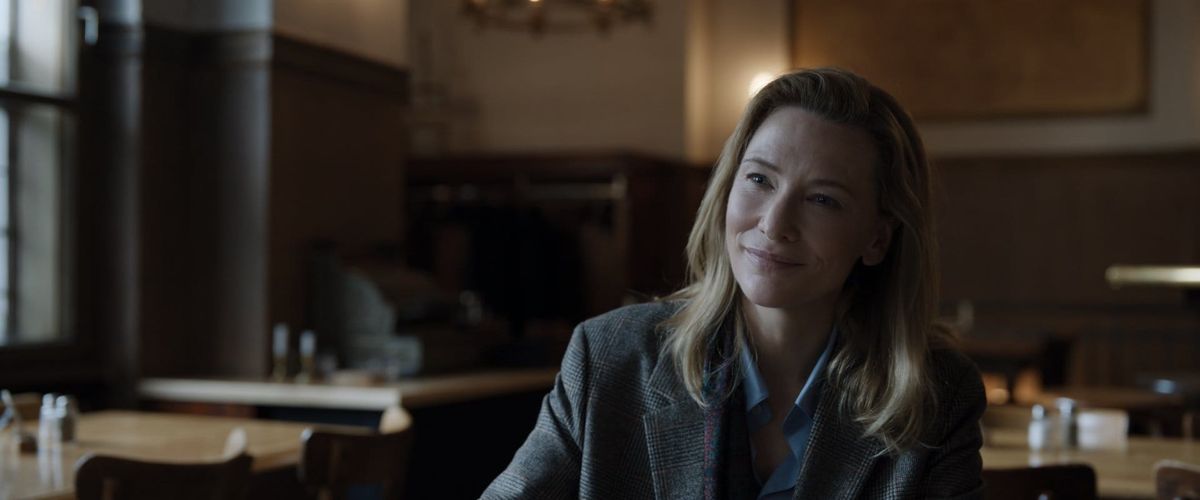
There is a temptation to describe TÁR as a film about power, and an equally strong temptation to reduce it to the cultural debates that surrounded its release, but Todd Field has made something considerably more elusive than either of those readings suggests.
This is not a film about a celebrated conductor losing her position, nor is it simply a drama about institutional accountability. It is a film about authorship—about who gets to compose the story of a life once the person who has spent decades controlling every interpretation suddenly discovers that interpretation no longer belongs to them.
That shift in emphasis changes the entire film. Lydia Tár does not merely conduct orchestras; she conducts conversations, relationships, reputations, and ultimately herself. She has built an identity so meticulously curated that performance and personality have become almost impossible to separate, and Field's film patiently dismantles that construction piece by piece until the distinction becomes unavoidable.
Lydia enters TÁR as one of the most accomplished artists in contemporary classical music. She is an EGOT winner, an internationally respected composer, the chief conductor of the Berlin Philharmonic, and an intellectual celebrity whose opinions carry the weight of institutional authority. Yet Field introduces these accomplishments with remarkable restraint, refusing to mythologize them even as everyone surrounding Lydia does. Prestige exists throughout the film not as validation but as architecture, creating rooms in which certain people are permitted to speak with absolute confidence while others quietly disappear into the background.
That architecture extends far beyond concert halls. It exists inside rehearsal rooms, apartments, interviews, academic spaces, and private relationships, revealing that power is never confined to official titles. It survives because people learn how to inhabit it, reinforce it, and eventually mistake it for permanence.
Cate Blanchett delivers one of the defining performances of the century because she understands that Lydia's authority is not innate but continuously maintained. Every sentence feels edited before it leaves her mouth. Every gesture carries deliberate precision. Every silence has purpose. Blanchett never allows Lydia to relax completely because someone who has built an identity around mastery can never truly stop performing.
What makes the performance extraordinary is its refusal to announce itself. Blanchett never reaches for grand emotional demonstrations or conspicuous displays of virtuosity. Instead, she builds Lydia through accumulation, allowing hundreds of tiny behavioural choices to form a complete psychological portrait. Confidence gradually reveals itself as choreography, intellect becomes another instrument of control, and composure begins to resemble labour rather than instinct.
The collapse that follows is therefore never dramatic in the conventional sense. Lydia does not suddenly become someone else. She simply loses the ability to sustain the version of herself she has authored for so long.
The supporting cast understands that their function is not to orbit Blanchett but to expose different dimensions of Lydia's carefully ordered world. Nina Hoss gives Sharon Goodnow remarkable emotional complexity, portraying a woman whose intelligence allows her to perceive fractures long before they become publicly visible. Sharon never functions merely as spouse or victim because Hoss recognizes that long relationships develop their own forms of negotiation, compromise, affection, and quiet resignation.
Noémie Merlant is superb as Francesca, communicating ambition, loyalty, frustration, and exhaustion with striking subtlety as someone trapped inside a professional hierarchy that demands constant obedience while offering very little certainty in return. Sophie Kauer brings an unaffected naturalism to Olga that proves quietly destabilizing precisely because she exists outside Lydia's established patterns of influence, while Julian Glover, Allan Corduner, and Mark Strong collectively reinforce the institutional ecosystem that has elevated Lydia to extraordinary heights.
Todd Field directs with remarkable confidence, demonstrating complete trust in duration rather than urgency. Scenes unfold without visible impatience, conversations continue long after another filmmaker might have cut away, and silence repeatedly accomplishes more than exposition ever could. The result is a film that asks viewers to observe power instead of merely listening to characters discuss it.
That patience becomes one of the film's greatest strengths because it reveals how authority actually operates. Control rarely announces itself through spectacular gestures. More often, it appears in interruptions, eye contact, carefully chosen words, subtle corrections, and assumptions that go unchallenged. Field understands that domination is frequently quiet, making its eventual instability all the more unsettling.
Florian Hoffmeister's cinematography reinforces this philosophy with extraordinary discipline. The compositions remain elegant without becoming ornamental, balancing architectural precision against an increasing sense of psychological unease. Modern interiors that initially communicate sophistication gradually begin to feel sterile, even oppressive, as though every immaculate surface conceals another unseen pressure.
The visual language never abandons realism, yet it slowly transforms familiar spaces into environments defined less by comfort than by observation. Lydia increasingly appears framed rather than liberated, surrounded by clean lines that begin to resemble invisible boundaries.
Sound performs an equally significant role throughout the film. Rather than relying upon an expressive score to guide emotional response, Field allows ordinary noises to accumulate until they acquire unsettling significance. Footsteps echo through empty corridors. Distant machinery hums beneath conversations. Breathing, creaking wood, passing traffic, and unexplained sounds gradually erode the certainty that Lydia's world remains fully comprehensible.
Those formal choices explain why TÁR increasingly resembles psychological horror despite never abandoning dramatic realism. Horror has never depended exclusively upon violence or the supernatural. At its most effective, it emerges when certainty itself becomes unstable, and Field quietly adopts that emotional grammar without ever embracing conventional genre conventions.
As Lydia's authority weakens, so too does her confidence that she remains the author of her own experience. Strange figures appear briefly before disappearing again. Dreams and memory begin to overlap. Time itself feels increasingly dislocated. The film never insists upon a single interpretation because uncertainty is precisely the point.
Classical music, meanwhile, functions as considerably more than professional backdrop. Conducting becomes an act of interpretation that mirrors the film's larger concerns with authorship, authority, and legacy. Lydia spends her career determining how audiences experience the work of others, shaping tempo, emotion, rhythm, and meaning with extraordinary confidence. Field quietly asks whether that instinct has extended beyond music into every aspect of Lydia's existence until interpretation itself has become indistinguishable from identity.
The film's treatment of institutional power proves equally nuanced because it resists both simplification and cynicism. Field neither argues that brilliance excuses exploitation nor suggests that artistic achievement becomes meaningless once personal misconduct enters the conversation. Instead, he examines the complicated mechanisms through which institutions reward certainty, protect prestige, and often confuse confidence with moral authority.
That refusal to simplify allows TÁR to remain intellectually demanding long after many contemporary prestige dramas have settled for familiar conclusions. Every answer produces another question, every certainty reveals another contradiction, and every revelation exposes yet another carefully maintained illusion.
The ending reflects that same discipline. Many viewers have interpreted it as humiliation or poetic justice, yet neither description feels entirely adequate because both assume the film has been building toward punishment. It has not. Field has been building toward displacement, removing Lydia from the centre of the story she has spent years composing until she can no longer determine how either her work or her life will be understood.
The final performance therefore carries an unexpected melancholy because the music itself survives unchanged while Lydia's relationship to it has fundamentally shifted. She remains capable of conducting, capable of interpreting, and capable of creating extraordinary work, but the mythology surrounding her has dissolved into something she can no longer orchestrate.
That distinction leaves TÁR with an ending that is neither triumphant nor vindictive, but quietly devastating in ways that continue unfolding after the credits have rolled. Todd Field understands that power rarely disappears overnight, just as identity rarely collapses in a single moment. Both erode through accumulated contradictions until the story someone has spent a lifetime telling about themselves can no longer contain the reality beneath it.
Rather than asking whether Lydia Tár deserves what ultimately becomes of her, the film poses a considerably more unsettling question about whether any of us remain the authors of our own lives once the narratives we have so carefully constructed begin slipping beyond our control. It is that lingering uncertainty, rather than any single plot development or cultural debate, that makes TÁR one of the defining achievements of contemporary cinema and one of the rare films that grows more complex the longer one sits with it.