The weight of becoming Genghis Khan.

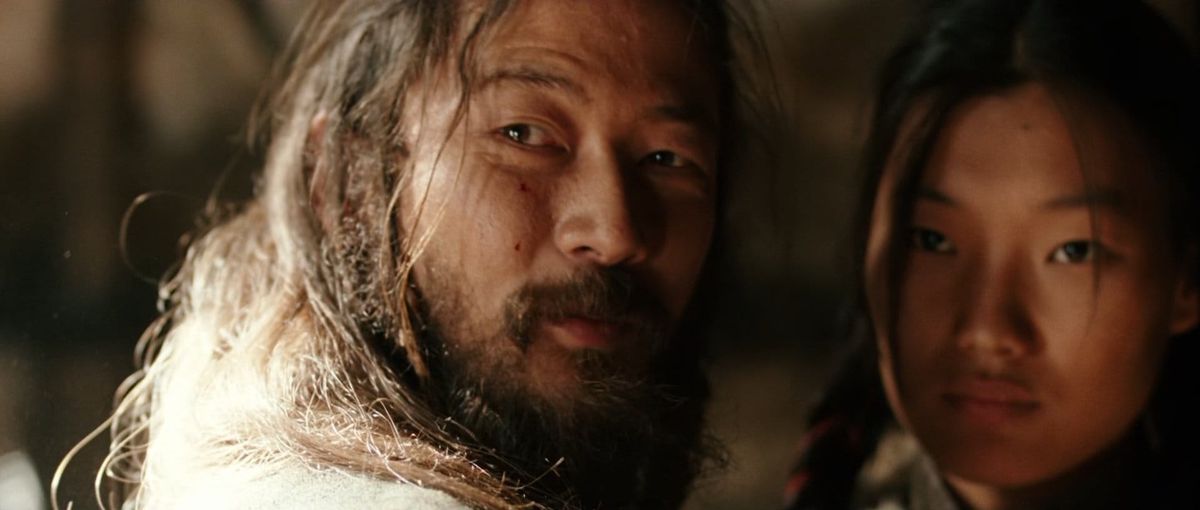
Some historical epics overwhelm with scale. Others overwhelm with violence. MONGOL does something more interesting than either. It strips one of history's most mythologized conquerors back to the years before the legend, before the empire, before the world knew the name Genghis Khan. Rather than asking how he conquered half the known world, the film asks how Temüjin survived long enough to become the man history remembers. It's a subtle distinction, but an essential one, because Sergei Bodrov's film isn't interested in celebrating conquest. It's interested in endurance.
That focus immediately separates MONGOL from the countless historical spectacles that mistake loudness for significance. The battles matter, but they never feel like the point. Every victory and every defeat exists to build a portrait of a man constantly shaped by betrayal, captivity, hunger and impossible choices. History often remembers rulers as finished products. MONGOL reminds us they began as frightened, wounded human beings.
The film's greatest strength is that it embraces uncertainty rather than pretending to possess definitive historical truth. So much of Temüjin's early life survives through oral traditions, conflicting chronicles and centuries of mythmaking that any adaptation inevitably becomes interpretation. Instead of disguising those gaps, Bodrov fills them with emotional plausibility. Whether every conversation happened exactly as depicted almost becomes irrelevant. The emotional journey feels authentic, even when the historical record remains elusive.
Tadanobu Asano delivers one of the most quietly commanding performances in modern historical cinema. His Temüjin rarely dominates scenes through speeches or theatrical displays of authority. Instead, leadership gradually emerges through resilience, patience and an almost unsettling calm. Even in moments of humiliation, Asano never lets the character lose his dignity. He understands that real strength often appears long before anyone else recognizes it.
Perhaps the film's most refreshing decision is refusing to portray Temüjin as either saint or monster. It avoids the simplistic temptation to rehabilitate him while also resisting the urge to foreshadow every future atrocity. This is not yet the conqueror whose campaigns would reshape Eurasia. This is a husband, prisoner, son, rival and survivor. The moral complexity remains intact because the audience is allowed to see both compassion and ruthlessness developing side by side.
Khulan Chuluun's Börte is equally vital to the film's success. Too many historical epics reduce wives to passive symbols waiting for rescue. Börte instead becomes one of the story's emotional anchors. Her intelligence, determination and unwavering partnership with Temüjin transform what could have been a conventional romance into something far more compelling. Their relationship isn't merely background motivation. It becomes the foundation upon which the future empire is emotionally constructed.
The chemistry between Asano and Chuluun carries remarkable weight because it never relies on melodrama. Their affection is expressed through shared hardship, mutual trust and quiet gestures instead of grand declarations. In a genre often obsessed with kings and generals, MONGOL quietly argues that history is equally shaped by relationships built away from the battlefield.
Visually, the film is magnificent without becoming self-conscious. Vast Mongolian landscapes dominate the frame with astonishing confidence. Endless grasslands, towering mountains and unforgiving winters constantly remind viewers how insignificant individuals appear against nature itself. These environments never function as decorative postcards. They actively shape the narrative, forcing characters into impossible decisions where survival becomes the only victory that matters.
The cinematography embraces natural light and expansive compositions that make even intimate scenes feel connected to something much larger. Horses thunder across open plains with breathtaking energy, while campsites illuminated by fire create moments of warmth amid relentless uncertainty. The result is a world that feels genuinely inhabited rather than constructed for spectacle.
Action sequences follow the same philosophy. They possess weight without chasing the exaggerated choreography common to many modern historical blockbusters. Every arrow fired and every sword strike feels dangerous because Bodrov prioritizes confusion, exhaustion and physical vulnerability over impossible heroics. Battles often conclude not with triumphant celebration but with weary relief.
The film's sound design deserves equal recognition. Wind, hoofbeats and silence frequently accomplish more than dialogue. Music arrives sparingly, allowing the landscape itself to become part of the emotional experience. It's an unusually restrained approach that trusts the audience to absorb atmosphere instead of constantly instructing them how to feel.
Where MONGOL occasionally stumbles is in its pacing. Because it covers so many formative episodes across Temüjin's early life, certain relationships and political developments receive less attention than they deserve. Characters occasionally disappear for long stretches before re-emerging with renewed importance, giving portions of the narrative a slightly episodic rhythm. The film rarely feels rushed, but it sometimes feels compressed.
Viewers expecting a comprehensive biography may also leave surprised. Major campaigns, imperial administration and the global consequences of Genghis Khan's rule remain largely outside the film's scope. That isn't necessarily a flaw, but it does mean the title promises something broader than the story ultimately delivers. This is only the opening chapter of a life whose historical impact extended far beyond these events.
Still, I found that limitation unexpectedly refreshing. Popular culture has spent decades portraying Genghis Khan primarily as an unstoppable military genius. MONGOL insists that greatness—however one chooses to define it—is forged through vulnerability before it ever manifests as power. That perspective doesn't excuse the destruction associated with his later reign, nor does it condemn him before those events unfold. It simply recognizes that history's most consequential figures are rarely born fully formed.
The film also succeeds because it treats Mongolian culture with visible respect. Costumes, customs, language and social structures feel integral to the story rather than decorative exoticism. There's a welcome sense that the filmmakers wanted audiences to inhabit this world instead of merely observing it from a comfortable distance. Even viewers unfamiliar with Mongolian history come away with a stronger appreciation for the social and environmental realities that shaped Temüjin's formative years.
Historical cinema often falls into one of two traps. Either it becomes so concerned with factual precision that drama disappears, or it sacrifices history entirely for entertainment. MONGOL navigates that divide with impressive confidence. It accepts that history can never be reconstructed perfectly while remaining deeply committed to capturing emotional and cultural truth. That's ultimately what gives the film its lasting power.
More than anything, MONGOL understands that legends are built one ordinary decision at a time. Before there was an empire stretching from the Pacific to Eastern Europe, there was simply a young man trying to survive another winter, protect the people he loved and navigate a world where loyalty could vanish overnight. By ending before the familiar image of Genghis Khan fully takes shape, the film preserves the mystery rather than exhausting it.
It isn't the definitive cinematic portrait of one of history's most consequential figures because no single film could ever achieve that. What MONGOL offers instead is something arguably more valuable: a thoughtful, visually stunning and emotionally grounded meditation on the fragile beginnings of an extraordinary life.