This is what you don’t touch.

BLACK BAG isn’t about espionage. It’s about the agreements people make to keep a relationship alive—and the quiet damage those agreements carry. Not trust as truth, but trust as restraint. Not what’s said, but what’s mutually agreed to remain unasked.
Steven Soderbergh pares the genre down until almost nothing is left but tension. Not action, not spectacle—tension as a condition. Two people, both trained to read deception, trying to coexist inside a system that rewards it. The film isn’t interested in who’s lying as much as how lying reshapes intimacy. That’s the engine. The leak, the investigation, the shifting suspicions—they function, but they’re scaffolding. What matters is the structure underneath: a relationship built on limits.
Everything in the film moves toward that boundary. The “black bag” itself—the line you don’t cross, the question you don’t ask—is framed like tradecraft, but it plays like a domestic contract. The kind that keeps things stable until it doesn’t. Every conversation circles it. Every exchange tests how much reality the relationship can absorb without collapsing. Information isn’t revealed so much as rationed. Dialogue becomes negotiation.
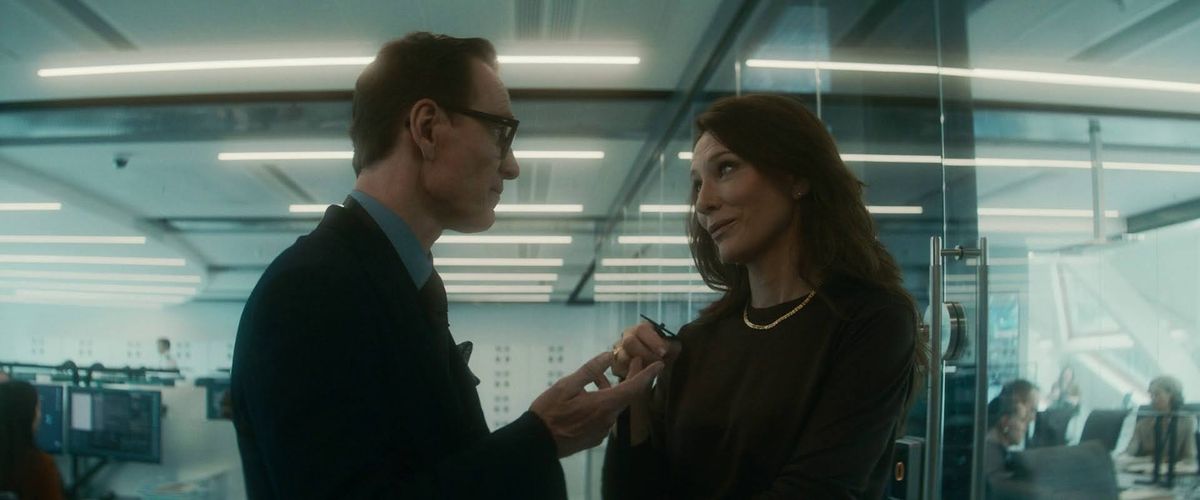
Michael Fassbender plays George like a man who doesn’t react so much as calibrate. Everything is measured, processed, filed away. You never quite see emotion land—you see it registered.
Cate Blanchett moves in the opposite direction. Kathryn understands that truth is flexible, situational, sometimes optional. She doesn’t resist the system; she works within it, bends it, survives it. Put them together and the film finds its rhythm: not chemistry, but containment. Not volatility, but pressure held just below the surface.
Formally, the film is locked in. Glass walls, clean frames, controlled lighting—spaces that suggest openness while enforcing distance. People are visible, but never fully accessible. The camera reflects that. It observes rather than intrudes, holding just far enough back to keep you outside the exchange. Even the pacing follows suit. It doesn’t build toward release so much as it tightens—slowly, deliberately—until you realize there isn’t going to be a real exhale. Silence isn’t empty here; it’s structural.
What’s notable is how the film understands power. Not as hierarchy, but as control over knowledge. Who knows what matters less than who chooses not to know. That’s where the relationship lives—not in declarations, but in omissions. The film is precise about that dynamic, even if it keeps its broader world abstract. Institutions exist, but more as conditions than systems with weight. The focus stays narrow, sometimes to a fault.
That restraint is the film’s strength and its limitation. It never breaks its own surface. It never lets things get messy in a way that feels uncontrolled or fully human. But that control is also the point. These are people who can’t afford rupture. Who’ve built entire lives around avoiding it. The film mirrors that discipline, even when it risks flattening emotional consequence in the process.
The plot resolves, but it doesn’t disrupt. The reveal lands less as a twist than as an inevitability—the outcome feels baked into the structure from the start. BLACK BAG isn’t trying to surprise you. It’s showing you how the system, both professional and personal, produces its own conclusions.
What lingers isn’t the mechanics of the investigation. It’s the condition the film leaves you in: the sense that closeness here is conditional, negotiated, always one question away from collapse. There’s a quiet sadness running through it—not dramatic, not overstated, but persistent.
BLACK BAG doesn’t ask whether you can trust someone. It asks how much you’re willing to not know in order to stay.