Where history actually lives.

There is a temptation to describe ROMA as a film about memory, and while that is true, it is also incomplete. Alfonso Cuarón is not simply reconstructing the Mexico City of his childhood with astonishing fidelity; he is interrogating the fragile architecture that memory builds around itself. This is not nostalgia. It is archaeology. Every room, every sound, every puddle reflecting the sky becomes evidence in an excavation of class, labour, family, and the people history quietly depends upon while rarely allowing them to speak for themselves.
That distinction matters because ROMA refuses to sentimentalize its past. Its beauty is undeniable, but it never mistakes beauty for innocence. The film understands that memory edits, softens, and mythologizes. Cuarón's achievement is recognizing that genuine remembrance requires resisting those impulses rather than surrendering to them.
Set in the Colonia Roma district of Mexico City during the early 1970s, the story follows Cleo, a live-in domestic worker employed by an upper-middle-class family whose comfortable routines begin to fracture under the weight of personal and political upheaval. Around her unfolds a country experiencing profound instability, from student protests to paramilitary violence, while inside the family home quieter forms of heartbreak accumulate with equal force.
Yet ROMA consistently rejects the idea that history only exists during moments of spectacle. Revolutions happen in the streets, but lives are more often defined by washing floors, putting children to bed, serving meals, folding laundry, and quietly absorbing grief without the luxury of expressing it. Cuarón's film understands that these acts are not interruptions to history. They are history.
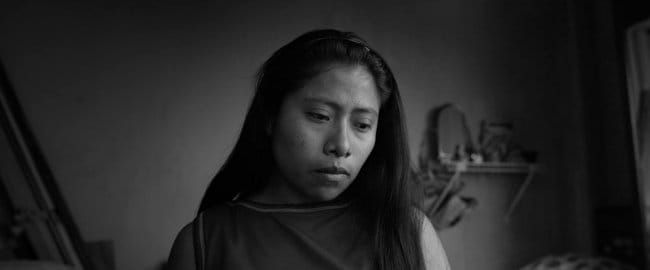
That perspective depends almost entirely upon Yalitza Aparicio, whose performance is one of the most remarkable screen debuts in modern cinema. Aparicio had never acted professionally before ROMA, and that absence of conventional technique becomes one of the film's greatest strengths. She never performs emotion for the audience. Instead, she exists within it. Cleo processes joy, humiliation, exhaustion, fear, and affection with such restraint that every subtle shift in expression carries extraordinary weight.
It is an extraordinarily difficult performance because it demands stillness rather than display. Cleo spends much of the film observing others, responding instead of initiating, yet Aparicio quietly anchors every scene she inhabits. She reminds us that invisibility is not emptiness. It is often something imposed.
Marina de Tavira, as Sofía, provides the film's essential counterbalance. Lesser films might reduce her to an indifferent employer or uncomplicated beneficiary of privilege, but Cuarón allows contradiction to define her. She is loving and neglectful, compassionate and oblivious, vulnerable and powerful, frequently all at once. Her own marriage collapses even as she remains structurally insulated from hardships Cleo can never escape.
Their relationship becomes the emotional centre of the film precisely because it resists resolution. Genuine affection exists between these women, yet affection cannot erase inequality. ROMA refuses the comforting fantasy that kindness dissolves hierarchy. Love may soften structural imbalance, but it cannot eliminate it.
The supporting cast contributes to this sense of lived reality rather than dramatic construction. Fernando Grediaga's emotionally distant Antonio barely needs to raise his voice for absence itself to become a defining characteristic. Jorge Antonio Guerrero gives Fermín an unnerving volatility that transforms fragile masculinity into something quietly terrifying, particularly as Mexico's broader political violence begins seeping into private life. Nancy García García brings warmth and weary humour to Adela, whose friendship with Cleo offers fleeting moments of solidarity inside systems designed to separate them.
Cuarón directs with extraordinary confidence, but never ostentation. The famously patient camera movements are often described as technical achievements, yet their significance is emotional rather than mechanical. The camera rarely rushes toward dramatic moments because life itself rarely announces when something irreversible is about to happen. Instead, it observes patiently, allowing tragedy to emerge naturally from ordinary space.
That formal restraint becomes one of the film's defining moral choices. Cuarón never manipulates viewers into feeling devastated. He trusts duration, silence, and careful observation. Emotion arrives because the film earns it rather than demands it.
The black-and-white cinematography is similarly revealing. It strips away nostalgic warmth while paradoxically making memory feel more tactile. Every reflection on wet pavement, every cloud drifting above rooftops, every texture inside the family home possesses astonishing clarity without becoming precious. The images feel remembered, not romanticized.
Equally remarkable is the sound design. ROMA contains very little non-diegetic music, allowing the world itself to become the score. Airplanes pass overhead with relentless regularity. Dogs bark. Vendors call from the streets. Children argue. Traffic hums endlessly in the distance. These sounds accumulate until Mexico City becomes less a setting than a living organism surrounding every character.
Setting, in ROMA, is never decorative. Cuarón understands geography as social structure. The architecture of the house reinforces invisible boundaries between employer and worker. The city's widening streets and crowded neighbourhoods reveal entirely different realities depending upon who is walking through them. Even the beach, which initially promises liberation, ultimately exposes how vulnerability follows Cleo wherever she goes.
The film's political dimension deserves equal attention because it refuses simplistic parallels between private suffering and national crisis. The Corpus Christi massacre arrives not as an isolated historical lesson but as a violent intrusion into everyday existence. Politics is never abstract here. It enters shops, hospitals, homes, relationships, and pregnancies. Cuarón understands that history does not merely happen around ordinary people. It happens to them.
What makes ROMA especially powerful is its refusal to convert Cleo into either martyr or symbol. Too often films about domestic workers ask audiences to admire endurance without questioning the systems demanding that endurance in the first place. Cuarón avoids that trap. Cleo possesses dignity because she is fully human, not because suffering somehow ennobles her.
That ethical attention distinguishes the film from many prestige dramas concerned with historical inequality. ROMA does not congratulate itself for noticing labour that society ignores. Instead, it quietly asks why that labour required cinematic recognition before so many viewers considered it worthy of sustained attention.
Its emotional climax demonstrates this philosophy perfectly. The sequence is devastating not because it manufactures spectacle but because everything preceding it has prepared us to understand precisely what is at stake. The restraint never breaks. Instead, it deepens until overwhelming emotion emerges almost despite the film's composure.
The closing moments offer neither triumph nor despair. They offer continuation. Cleo returns to work. Life resumes. Responsibilities remain. Structural inequalities persist. Yet something has shifted—not within society, but within our capacity to recognize the humanity that routine so easily obscures.
That ending encapsulates why ROMA continues to linger long after its final frame. It understands that hope and victory are not interchangeable. Victory changes systems. Hope merely allows people to survive within them a little longer. Cuarón refuses to confuse one for the other.
ROMA is therefore not simply a masterpiece of memory. It is a profound examination of attention itself. It asks what happens when cinema finally looks—patiently, honestly, without embellishment—at the people history has always depended upon while too rarely allowing them to occupy its centre. In doing so, it transforms remembrance from an act of nostalgia into an act of responsibility, and leaves behind not certainty, but a quieter, more demanding form of understanding.