Winning at any cost.

George Clooney’s THE IDES OF MARCH begins with a microphone check, an empty auditorium and Ryan Gosling standing behind a podium that does not belong to him, which is an appropriately understated introduction for a film fascinated by the people who manufacture political power while somebody else stands beneath the lights. From its opening moments, the film establishes politics as both profession and performance, where the speeches delivered before cheering crowds are only the visible surface of a much more complicated machinery operating behind them.
Adapted from Beau Willimon’s play FARRAGUT NORTH, the film follows Stephen Meyers, a gifted young communications strategist working for Pennsylvania Governor Mike Morris during a fiercely contested Democratic presidential primary. Stephen already understands polling, messaging, opposition research and the transactional nature of campaigning, but unlike many of the more experienced professionals surrounding him, he still possesses genuine belief in both his candidate and the possibility that politics can accomplish something worthwhile.
That belief becomes the foundation upon which THE IDES OF MARCH operates, because Clooney is considerably less interested in announcing that politicians can lie than in examining the pressures placed upon people who enter political systems believing they can retain control of their own principles. Political corruption is hardly unexplored cinematic territory, but the film approaches it through gradual moral pressure rather than sensational revelation, allowing seemingly minor decisions to accumulate until the distinction between pragmatism and compromise becomes increasingly difficult to identify.
Stephen is not a political innocent, which immediately makes him more interesting than the familiar idealist wandering into Washington without understanding how campaigns operate. He is already extremely good at his job, comfortable manipulating narratives and managing journalists, while his confidence comes partly from believing that understanding the game makes him less vulnerable to its uglier consequences.
Ryan Gosling is exceptionally well suited to that ambiguity, because Stephen needs to appear simultaneously intelligent, ambitious, charming and just self-assured enough to underestimate the people around him. Gosling never exaggerates those characteristics, instead allowing Stephen’s confidence to emerge naturally through the speed with which he processes information and the casual authority with which he moves through campaign spaces.
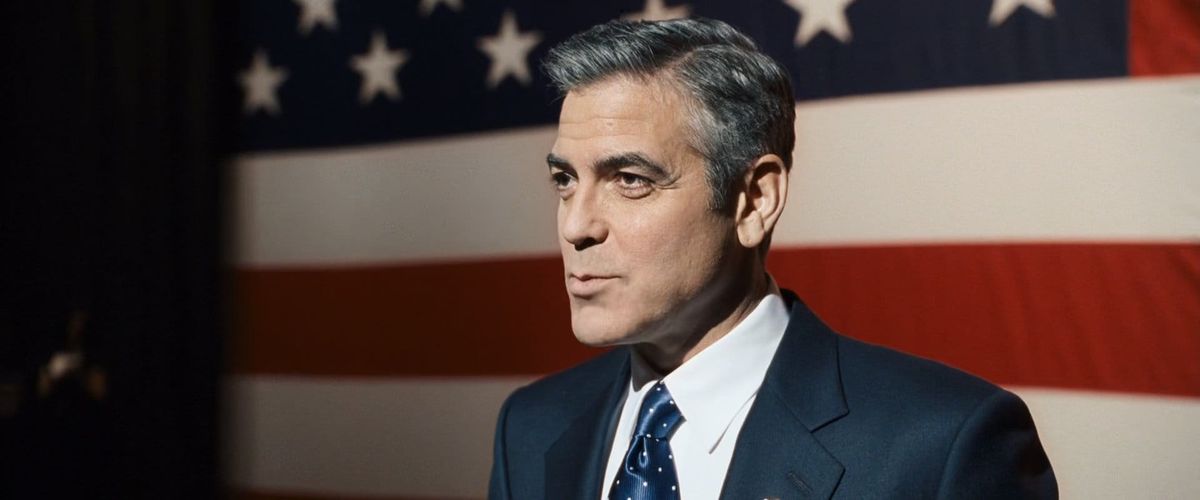
His candidate initially appears worthy of that confidence, with Clooney himself playing Morris as articulate, charismatic and unusually willing to express political positions with conviction. Clooney uses his own considerable screen presence intelligently, making Morris feel like precisely the sort of candidate capable of convincing talented young professionals that electoral politics might still represent something larger than personal advancement.
Morris speaks about religion, taxation, foreign policy and social issues with the confidence of someone who appears to possess an actual worldview rather than a collection of focus-group-tested slogans. Whether every element of that image survives closer examination becomes part of the film’s tension, but Clooney wisely makes Morris persuasive enough that Stephen’s admiration never seems foolish or artificially constructed.
The film consequently avoids one of the easiest traps available to political dramas, where the supposedly inspiring politician is so obviously compromised that the audience spends most of the running time waiting for the protagonist to catch up. Morris is more complicated than that, while THE IDES OF MARCH remains interested in the uncomfortable possibility that political conviction and personal imperfection can coexist within the same person.
Stephen’s immediate superior is Paul Zara, Morris’s veteran campaign manager, and Philip Seymour Hoffman gives him the weary intelligence of someone who has spent enough time around elections to understand which principles can survive political reality. Paul knows campaigns manipulate narratives and candidates make compromises, yet he retains an almost stubborn belief in loyalty as one of the few currencies within politics that still means something.
Hoffman is magnificent because he never reduces Paul to the familiar image of a cynical backroom operator barking orders at younger staff members. There is warmth beneath his exhaustion and something almost paternal in his relationship with Stephen, which gives their conversations an emotional dimension extending well beyond campaign strategy.
Paul’s counterpart on the opposing campaign is Tom Duffy, played by Paul Giamatti with exactly the sort of slippery intelligence that makes every apparently casual conversation feel dangerous. Duffy recognizes Stephen’s talent immediately, but he also recognizes the ambition underneath it, and the resulting interactions between them provide some of the film’s sharpest examinations of how political professionals evaluate one another.
Giamatti and Hoffman are particularly effective because neither actor treats political experience as omniscience. Their characters are simply men who have spent long enough inside campaigns to understand that people reveal themselves through the choices they make when confronted with pressure, while Stephen has not yet accumulated enough scars to recognize every trap before stepping near it.
One of the film’s central conflicts begins with a seemingly straightforward professional decision that becomes considerably more complicated because information inside a presidential campaign is never neutral. Stephen believes intentions should matter, while the older professionals surrounding him understand that appearances, consequences and leverage can matter considerably more.
That distinction allows Clooney to build tension without relying upon assassination attempts, conspiracies or other conventional political-thriller machinery. Nobody needs to carry a gun when a private conversation, misplaced piece of information or moment of professional disloyalty can alter several careers simultaneously.
Much of THE IDES OF MARCH consequently unfolds in hotel rooms, restaurants, cars, corridors and campaign offices, which makes its political environment feel unusually convincing. The public campaign contains flags, podiums, television cameras and cheering supporters, while the decisions shaping that campaign are frequently made in spaces so ordinary that the contrast becomes quietly unsettling.
Cinematographer Phedon Papamichael emphasizes that division without drawing unnecessary attention to it, repeatedly separating the carefully illuminated public image of politics from the darker, more intimate spaces where strategy actually develops. The visual approach is controlled rather than flashy, complementing Clooney’s preference for letting actors, conversations and silences generate tension.
Alexandre Desplat’s score operates with similar restraint, providing an undercurrent of unease without insisting that every development represents some enormous political revelation. The music understands the scale of the story, which is ultimately less about the fate of the United States than about the moral education of one extraordinarily talented young political operative.
Stephen’s relationship with Molly Stearns, a young campaign intern played by Evan Rachel Wood, introduces another dimension to that education. Their interactions initially possess the casual flirtation and compressed intimacy that might plausibly emerge among people spending almost every waking hour inside the artificial ecosystem of a presidential campaign.
Wood prevents Molly from becoming merely a narrative device by giving her confidence, humour and a clear awareness of the environment around her. She is younger than many of the principal characters and occupies considerably less institutional power, but she is never presented as stupid or oblivious to the complicated relationships surrounding the campaign.
As Stephen becomes more involved with Molly, however, he begins discovering that political secrets rarely remain confined to the people who originally created them. The film gradually reveals how personal decisions can acquire enormous institutional consequences once they intersect with ambition, reputation and the possibility of public exposure.
This is where THE IDES OF MARCH becomes considerably darker without needing to abandon the restraint that defines its first half. Clooney understands that the most unsettling political scandals are not necessarily interesting because of their salacious details, but because they reveal the enormous differences in power between the people involved.
Information means something different to everyone who possesses it, with one person potentially seeing a private problem where another sees a professional threat and somebody else sees leverage. The film repeatedly returns to that idea until information itself begins functioning almost like currency, becoming valuable according to who knows it, who wants it and who cannot afford for somebody else to reveal it.
Marisa Tomei’s journalist Ida Horowicz fits perfectly within that ecosystem, because her relationship with Stephen is simultaneously friendly, professional and adversarial. Ida understands that campaigns need journalists while journalists need campaigns, but neither side is ever obligated to protect the other when their interests diverge.
Tomei avoids turning Ida into either a heroic defender of democracy or a predatory reporter looking to destroy politicians for entertainment. She is simply extremely competent at her job, which means recognizing that information has value precisely because somebody would prefer that it remain private.
Stephen initially believes he can manage that relationship as confidently as he manages everything else, yet Ida provides another reminder that nearly everyone surrounding him operates according to obligations extending beyond personal friendship. The film’s political world is filled with people who can genuinely like one another while remaining perfectly willing to act against each other when their professional interests demand it.
That observation is essential to the film’s understanding of loyalty, because THE IDES OF MARCH never suggests that its characters are incapable of affection or friendship. Instead, it examines what happens when those relationships exist inside institutions where careers, reputations and enormous amounts of political power depend upon decisions that cannot always accommodate personal loyalty.
The screenplay, written by Clooney, Grant Heslov and Willimon, is especially strong when allowing these competing obligations to emerge naturally through dialogue. Characters rarely explain the political system for the audience because everyone within the story already understands the environment, leaving viewers to absorb its rules through observation.
That confidence helps the film avoid becoming a lecture about American democracy, despite containing plenty of ideas about electoral politics. The Democratic primary setting provides the structure, but the larger subject is institutional power and the behaviour it encourages among ambitious people.
Stephen becomes increasingly compelling because his greatest weakness is closely connected to his greatest strength. He is intelligent enough to understand political strategy exceptionally quickly, but that intelligence also encourages him to believe he can remain one move ahead of people who have been navigating these environments for decades.
Gosling captures that youthful certainty without making Stephen arrogant enough to become irritating. There is genuine enthusiasm underneath his ambition, and the film allows us to understand why someone with his abilities would find campaigning intoxicating.
Campaigns compress enormous stakes into incredibly short periods of time, while every poll, endorsement, interview and mistake appears capable of changing the direction of history. For someone like Stephen, that environment offers an irresistible combination of competition, intellectual challenge and proximity to power.
The film is particularly perceptive about how quickly proximity to power can begin feeling like power itself. Stephen does not hold elected office and nobody attending a rally has come to see him, yet he helps determine what Morris says, how the media interprets it and which political battles the campaign chooses to fight.
That influence creates its own form of intoxication, especially because the people exercising it can convince themselves that their decisions are justified by the importance of the candidate they serve. If Morris represents the better future Stephen genuinely believes he does, almost any tactical compromise can begin looking defensible when compared with the possibility of losing.
Clooney refuses to tell the audience exactly where acceptable strategy ends and moral surrender begins. Instead, he places Stephen in situations where every available decision carries consequences, gradually narrowing the distance between what is politically effective and what is personally defensible.
The title naturally evokes Julius Caesar, political betrayal and the danger hidden within supposedly loyal relationships, but the reference works because betrayal in this story is considerably more complicated than one obvious Brutus raising a knife. Loyalty changes according to perspective, and people who consider themselves betrayed may simultaneously be betraying somebody else.
That ambiguity gives the film considerably more substance than a straightforward story about corrupt politicians exploiting innocent people. Almost everyone operates according to a recognizable internal logic, and the screenplay rarely grants viewers the comfort of dividing its characters neatly into heroes and villains.
Even Paul and Duffy, who represent considerably more seasoned approaches to campaigning, are not simple opposites. Both understand that politics can be ruthless, yet their personal codes differ enough to reveal that cynicism itself has varieties.
Hoffman gives Paul a battered sense of principle, particularly regarding loyalty, while Giamatti makes Duffy more openly comfortable with treating political relationships as strategic opportunities. Watching Stephen move between those philosophies becomes one of the film’s pleasures, especially because he initially believes himself capable of taking whatever knowledge he needs without inheriting the worldview behind it.
Clooney’s performance deserves more credit than it sometimes receives because Morris could easily become the least interesting character in his own political drama. Instead, Clooney understands that the candidate’s relative distance from the narrative is part of the point, since campaigns often transform politicians into symbols interpreted through the people surrounding them.
Morris exists simultaneously as a man, a candidate, a collection of policies, an employer and a potential president, with each identity carrying different expectations. Stephen’s relationship is therefore not simply with Mike Morris the individual but with everything Morris represents to him.
That makes the film’s exploration of disillusionment considerably richer, because disappointment with a person does not automatically erase belief in the ideas associated with that person. Political morality becomes uncomfortable precisely because worthy causes can be represented by imperfect people, leaving those around them to decide how much imperfection they are willing to tolerate.
The supporting ensemble gives those questions unusual weight, with Hoffman, Giamatti, Tomei, Wood, Jeffrey Wright and Jennifer Ehle filling even relatively limited roles with enough personality to suggest lives extending beyond Stephen’s immediate perspective. Few political thrillers possess this much acting talent without allowing the ensemble to become distracting.
Clooney keeps everyone operating within the same tonal register, creating a film where the performances feel conversational even when the stakes become enormous. Nobody behaves as though they know they are participating in a political thriller, which allows tension to emerge from circumstances rather than performance.
That restraint also prevents the film from becoming excessively bulky despite the density of its themes. At approximately 100 minutes, THE IDES OF MARCH moves with remarkable efficiency, rarely lingering on a development after its implications have become clear.
The screenplay trusts viewers to connect information without repeatedly explaining what each revelation means, while Clooney’s direction gives important conversations enough room to breathe. The result is a film that feels intellectually substantial without becoming dramatically heavy.
Its relatively compact running time also means that Stephen’s evolution occurs quickly, which fits the compressed reality of a political campaign. Decisions that might take months to unfold in another profession can become existential within hours when an election is approaching and every newspaper headline threatens to alter momentum.
That pressure becomes increasingly important as the film progresses, because Stephen’s choices cannot be separated from the speed at which he is forced to make them. The campaign never stops long enough for anyone to conduct a leisurely moral inventory, leaving characters to make decisions while simultaneously protecting themselves from the consequences of previous ones.
This is ultimately where THE IDES OF MARCH finds its bleakest insight, because corruption is presented less as a dramatic transformation than as a gradual recalibration of what someone considers acceptable. One compromise establishes the conditions for another, while each subsequent decision can be justified by the circumstances created by the previous one.
The film does not require Stephen to suddenly abandon everything he believes, because a transformation that obvious would be considerably easier to recognize and resist. Instead, it examines how principles can be modified incrementally until someone reaches a position that an earlier version of himself might have found unimaginable.
Gosling becomes increasingly impressive as that process develops because he communicates much of it through changes in Stephen’s composure. His early confidence has an almost playful quality, while later scenes reveal someone becoming more careful about what he says, what he reveals and what other people might want from him.
The change is subtle enough that viewers are never handed a convenient moment where Stephen can be declared an entirely different person. He remains recognizably himself throughout, which is exactly why the film’s moral argument works.
People rarely become compromised by transforming into strangers overnight, because they usually retain the same intelligence, humour, ambitions and insecurities while gradually changing the rules according to which they use them. THE IDES OF MARCH understands that continuity, allowing Stephen’s strengths to remain intact even as his understanding of power becomes increasingly sophisticated.
The film’s cynicism is therefore more complicated than the familiar declaration that politics is inherently rotten. It does not argue that everyone involved is secretly terrible, nor does it suggest that political ideas are meaningless because the people advocating them can be flawed.
Paul genuinely values loyalty, Stephen genuinely believes in Morris, Morris appears to possess genuine political convictions and Ida genuinely believes in doing her job. The tragedy comes from placing those beliefs inside an environment where maintaining them can become increasingly expensive.
That distinction keeps the film from becoming nihilistic, because values matter precisely because abandoning them carries consequences. If nobody believed anything from the beginning, there would be nothing for the political system to erode.
Clooney is consequently less interested in exposing corruption than in studying accommodation, particularly the process by which talented people learn to survive institutions whose demands gradually conflict with their original values. The film never needs to declare whether Stephen ultimately makes the correct choices, because its more interesting question concerns what those choices require him to become.
By its final stretch, the political maneuvering has tightened considerably, but the film remains focused upon character rather than electoral arithmetic. Poll numbers and endorsements matter because they create pressure, yet the lasting tension comes from watching Stephen understand more about the environment than he did when the story began.
The title’s Shakespearean historical weight might suggest an explosive conclusion filled with betrayal and dramatic reckoning, but Clooney remains committed to understatement. His interest lies in the quieter realization that political systems do not necessarily destroy talented people who learn to compromise, because they can just as easily reward them.
That possibility gives THE IDES OF MARCH its lingering discomfort. The film understands that institutional success and moral success are not synonymous, while the skills required to achieve one can sometimes undermine the other.
Stephen’s journey consequently becomes less about whether he can survive the campaign than about what survival means once every relationship has acquired strategic value. Gosling carries that ambiguity beautifully, allowing Stephen to become more formidable without making the transformation feel artificially sinister.
The film closes with an image entirely consistent with everything preceding it, emphasizing communication, performance and the enormous significance of what political professionals choose to say or leave unsaid. Clooney resists tying every moral question into a neat conclusion, allowing the accumulated weight of Stephen’s experiences to provide the final judgment instead.
More than fifteen years after its release, THE IDES OF MARCH remains an exceptionally effective political drama because its central argument does not depend upon a particular election or ideological moment. The Democratic primary provides its setting, but the underlying dynamics of ambition, loyalty, institutional pressure and reputation can exist anywhere people compete for access to power.
Its strongest insight is that corruption rarely introduces itself as corruption, because compromise usually arrives carrying a perfectly reasonable explanation. Someone is protecting a candidate, preserving a career, preventing an opponent from winning or ensuring that an important cause survives long enough to matter, while each justification makes the next concession slightly easier.
Clooney directs that process without sensationalism, trusting an extraordinary ensemble and a sharp screenplay to create tension from conversations rather than spectacle. Hoffman and Giamatti provide two superbly contrasting portraits of political experience, Tomei gives journalism its own transactional logic, Wood ensures the human consequences never disappear beneath campaign strategy, and Clooney makes Morris charismatic enough to justify the loyalty surrounding him.
At the centre of everything is Gosling, whose performance turns Stephen Meyers into something considerably more complicated than either idealist or opportunist. His greatest accomplishment is preserving enough of Stephen’s original personality throughout the film that every development feels like adaptation rather than replacement.
That makes THE IDES OF MARCH considerably sadder than a conventional story about someone discovering that politics is corrupt, because Stephen already knows politics can be ugly when the film begins. What he has yet to understand is how quickly intellectual awareness of compromise can become personal participation in it.
The difference between those forms of knowledge becomes the film’s real subject, with Stephen discovering that recognizing the machinery from a distance is nothing like realizing that he has become one of its moving parts. Clooney leaves enough moral ambiguity for viewers to decide how severely Stephen should be judged, while providing little reason to doubt that the campaign has permanently changed the way he understands power.
THE IDES OF MARCH ultimately succeeds because it refuses to confuse cynicism with sophistication, instead recognizing that the most compelling political stories are not necessarily about proving everyone corrupt. They are about examining why intelligent people compromise themselves, how institutions make those compromises appear reasonable and what remains once ambition has learned to speak the language of necessity.
Clooney’s film offers no comforting answer to those questions, but it does offer an exceptionally controlled examination of them, carried by one of the strongest ensembles assembled for an American political drama of its era. Beneath the speeches, polling numbers and campaign maneuvering sits a much more intimate story about loyalty, belief and the price of discovering how power actually works, which is precisely why THE IDES OF MARCH remains so quietly unsettling long after the campaign itself has ended.