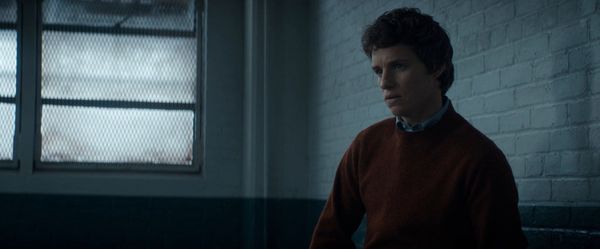
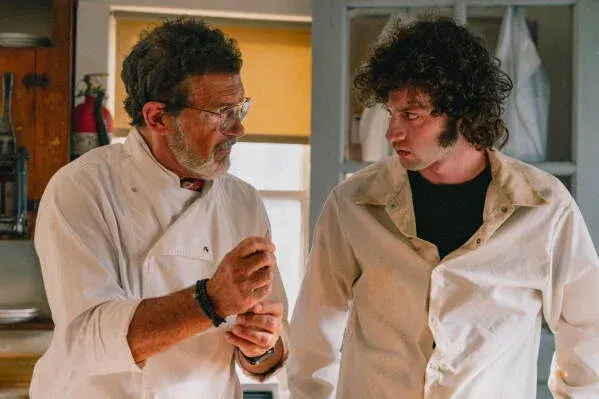
Judgment came before understanding.

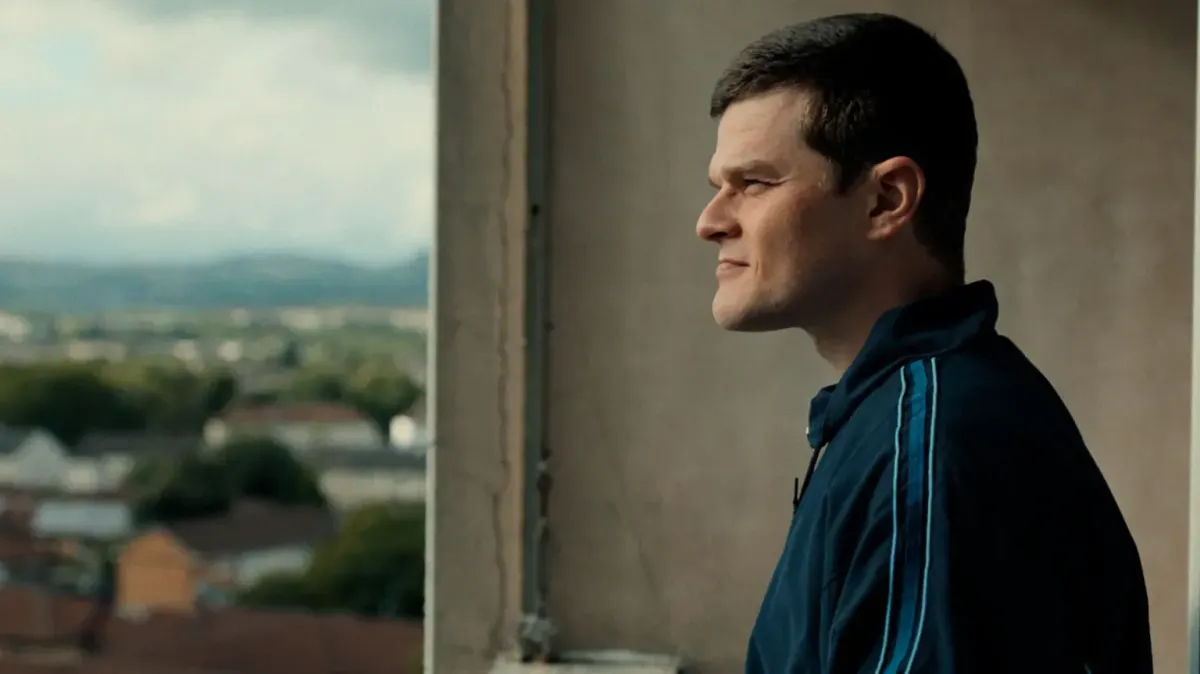
There are films about disability that want you to admire their subjects. I SWEAR wants you to understand one, and that distinction matters.
Kirk Jones’ biographical drama about Scottish Tourette syndrome campaigner John Davidson could easily have become the sort of inspirational biopic where disability becomes an obstacle course and perseverance becomes personality. Eventually everyone learns a valuable lesson, the music swells, and the credits roll.
Thankfully, I SWEAR is considerably more perceptive than that. Rather than presenting Tourette syndrome as a narrative device or inspirational obstacle, it examines what it means to live with a highly visible neurological condition in a world largely built around behavioural conformity.
Beginning in 1980s Scotland, the film follows Davidson from adolescence into adulthood as Tourette syndrome radically changes how he moves through the world. Scott Ellis Watson plays the younger John before Robert Aramayo assumes the role as an adult, carrying years of embarrassment, frustration and social isolation with him.
That period matters because Davidson’s story unfolds before neurodivergence had entered ordinary conversation and when public understanding of Tourette syndrome rarely extended beyond crude stereotypes. Difference could easily be interpreted as misbehaviour because the people and institutions surrounding Davidson simply lacked the knowledge to recognize anything else.
Teachers see disruption, strangers hear obscenity, and people interpret involuntary behaviour using rules designed for voluntary behaviour. John is consequently left dealing with the consequences of intentions he never had.
The historical setting also prevents the film from applying contemporary language too neatly to Davidson’s experiences. John doesn’t have immediate access to the vocabulary that might help him understand himself, while many of the people around him lack even the basic knowledge required to recognize Tourette syndrome.
That absence of language matters because when a society cannot properly describe a condition, the behaviour associated with it can easily become a question of character instead. Neurological difference becomes supposed rudeness, aggression or disobedience, and the individual is judged accordingly.
That gets at one of the film’s most interesting ideas about disability. Tourette syndrome creates genuine difficulties for John, but many of the barriers affecting his life are created or intensified by the way other people respond to it.
It’s essentially the social model of disability without Jones waving a textbook at the audience. The problem isn’t exclusively what John’s body does, but also that the environments around him were never designed to accommodate somebody whose body behaves differently.
That distinction prevents I SWEAR from suggesting that every problem in John’s life could disappear through treatment or greater self-control. Medical intervention has its place, but social participation depends on something medicine cannot prescribe: other people being willing to make room.
Jones approaches this material with admirable restraint, and his direction rarely competes with the humanity of the story. Instead, he trusts performances, conversations and ordinary interactions to carry much of its emotional weight.
There’s no attempt to turn Tourette syndrome into visual spectacle. Jones understands that the camera itself can participate in the way disability is perceived, and he generally refuses to photograph John as though the audience has purchased a ticket to stare at him.
That restraint doesn’t mean the filmmaking is flawless. The photography is handsome without being particularly distinctive, the emotional rhythms are familiar, and you can occasionally feel the machinery of the inspirational British biopic turning beneath the performances.
There are moments when the film tells you exactly when to hurt and exactly when to feel hopeful. Jones occasionally tidies something that might have been more interesting if left uncomfortable, giving I SWEAR a conventional streak that sits somewhat awkwardly beside the complexity of its subject.
Biographical dramas frequently stumble into this problem because complicated lives must be compressed into narrative arcs. People become representative of particular attitudes, and decades of uncertainty begin looking suspiciously coherent once arranged into two hours of cinema.
I SWEAR doesn’t completely escape that machinery, but Jones rarely allows it to become dishonest. His film is most effective when it slows down and simply watches John navigate circumstances that other people would barely consider worth remembering.
Robert Aramayo is phenomenal, delivering one of the year’s finest performances. The obvious temptation with a role like this is to concentrate on technical imitation because the movements, vocalizations and sudden physical interruptions are the most immediately visible aspects of playing Davidson.
Aramayo gets them right, but his performance really lives between them. There’s embarrassment, irritation, exhaustion, humour and an almost constant awareness of how everybody else in the room might react.
He plays John like somebody who has spent years monitoring other people’s responses to his own body. Sometimes an apology seems ready before anyone has even responded, revealing how thoroughly that expectation has become embedded in him.
That detail becomes particularly important because apologizing can function almost like another form of social accommodation. John cannot necessarily control the behaviour, but he can attempt to manage the discomfort it produces in everybody else.
Aramayo captures how exhausting that becomes, particularly because there’s a difference between living with Tourette syndrome and constantly explaining Tourette syndrome. His performance understands the emotional labour separating those experiences without needing to verbalize it.
The tics aren’t the entirety of the performance because John’s relationship with them is considerably more important. That distinction prevents Aramayo’s work from becoming mimicry and allows Davidson to remain a complete person rather than a technical acting exercise.
His physical performance is impressive precisely because it eventually stops demanding attention. The longer Aramayo inhabits Davidson, the easier it becomes to stop watching the mechanics and start watching the person.
Scott Ellis Watson deserves considerable recognition for portraying the younger John. His performance establishes much of the emotional foundation Aramayo later builds upon, and the transition between them feels like one life continuing rather than two actors sharing a character.
Watson also has the difficult responsibility of depicting the period when John has the least understanding of what is happening to him. Confusion becomes as important as the symptoms themselves because suddenly his own body can violate social expectations before he understands why.
Together, Watson and Aramayo create a remarkably coherent portrait. The performances differ because John himself changes, but there is enough shared emotional language between them to make adulthood feel like accumulation rather than reinvention.
That continuity is particularly important because I SWEAR treats Tourette syndrome as lived experience rather than a convenient plot device. John isn’t reduced to a collection of symptoms waiting for the screenplay to teach everyone around him tolerance.
He remains stubborn, embarrassed, funny, frustrated, hopeful and occasionally pissed off, allowing disability to shape his life without becoming the entirety of his personality. The film grants him contradictions that disability dramas too often sacrifice in favour of uncomplicated inspiration.
That is a deceptively important achievement because representation becomes considerably less meaningful when disabled characters are required to be endlessly courageous, sympathetic or morally instructive. John is allowed to be difficult sometimes because people are difficult sometimes, and equality includes the right to be imperfect without every imperfection being interpreted as evidence about an entire disability.
The humour is essential to that approach because I SWEAR is frequently very funny. That could have gone catastrophically wrong, but Jones understands that refusing humour altogether would be another form of dishonesty.
The film finds comedy in circumstances without treating John’s humanity as the punchline. Laughter becomes part of his life rather than evidence that the film isn’t taking his condition seriously, giving the heavier passages greater impact because these characters are allowed to actually live.
That distinction is particularly important with Tourette syndrome because popular culture has often reduced the condition to involuntary obscenities. I SWEAR acknowledges that coprolalia can produce funny situations without pretending that swearing is either the entirety of Tourette syndrome or an invitation to ridicule the person experiencing it.
Humour also gives Davidson agency because he isn’t simply the person everybody else reacts to. He is capable of recognizing absurdity himself and participating in the comedy of his own circumstances, which keeps the film from placing him behind glass.
Maxine Peake brings extraordinary warmth to Dottie, a mental health nurse who becomes an important presence in John’s life. What works about Peake’s performance is how little ceremony she gives basic human decency.
Dottie doesn’t behave as though treating John with dignity deserves a medal. She listens, adjusts and recognizes how important independence is to him, understanding that supporting somebody doesn’t mean controlling them.
Peake’s restraint prevents Dottie from becoming the saintly nondisabled saviour who frequently appears in films about disability. Her importance comes not from rescuing John but from refusing to assume that he requires rescuing in the first place.
Peter Mullan brings a similarly unfussy humanity to Tommy, a community-centre caretaker who develops a relationship with John. Mullan is wonderfully understated, giving Tommy a warmth that never turns him into another inspirational-biopic saint.
Tommy’s importance comes through ordinary trust, with work, routine and responsibility becoming meaningful because John is given an opportunity to demonstrate what he can do. He is no longer permanently judged according to what other people assume he cannot.
Together, Dottie and Tommy represent something approaching collective access because they don’t demand that John completely reshape himself to fit their environments. They make room for him within them, turning accommodation into something ordinary rather than charitable.
Collective access is one of the disability-justice ideas I kept returning to while watching I SWEAR. Communities become genuinely accessible when responsibility for inclusion is shared rather than placed entirely on the disabled person.
That means John shouldn’t always be the person explaining, apologizing, suppressing or adapting. Sometimes the room itself needs to change, and sometimes the people inside it simply need to become more patient.
That distinction is particularly important because I SWEAR recognizes that independence doesn’t mean needing nobody. Everyone depends on other people, while disability merely makes certain forms of support more visible.
Society has an unfortunate tendency to interpret visible support as evidence of incapability. Jones pushes against that assumption by showing that assistance and independence can comfortably coexist rather than functioning as opposites.
James Blann’s cinematography follows Jones’ preference for intimacy over spectacle. The camera remains close to the characters without turning John’s physicality into an exhibition, an especially important choice in a film where staring itself can carry uncomfortable social weight.
There’s an interesting ethical dimension to that visual approach because cinema is fundamentally an act of looking. I SWEAR rarely makes the audience feel as though Davidson has been placed under glass for examination, instead observing relationships and reactions as closely as physical behaviour.
Stephen Rennicks’ score works similarly, reinforcing emotion without constantly announcing what the audience should feel. Some of the film’s strongest passages are allowed enough quiet for Aramayo and the surrounding cast to carry them without musical instruction.
That quiet is useful because I SWEAR is ultimately a film about communication. Words can fail, bodies can communicate things their owners never intended, and silence can sometimes offer more understanding than another explanation.
The film’s accessibility remains both a strength and limitation. I SWEAR communicates Davidson’s experience extremely effectively, but some supporting characters feel closer to representations of ignorance, kindness or cruelty than fully developed people.
Reality is messier than the film occasionally allows it to be because prejudice rarely announces itself neatly, compassion can coexist with ignorance, and people who genuinely care about someone can still fail them spectacularly. The screenplay occasionally smooths those contradictions into clearer emotional categories, making the film easier to follow but slightly less challenging than it might otherwise have been.
The film’s strongest broader observation concerns normality itself. Society builds expectations around how people should speak, move, behave, work and occupy public space, and most people never notice those expectations because they can satisfy them without thinking.
Disability justice has a term for part of this in hegemonic normalcy, the assumption that there is a correct or desirable way for bodies and minds to function. John continually collides with that assumption simply because his behaviour falls outside what other people consider acceptable.
A quiet room assumes control over speech, a conversation assumes control over language, and public etiquette assumes that intention and behaviour are connected. Tourette syndrome fucks with those assumptions, exposing how much supposedly ordinary social interaction depends upon conformity.
That is where the film becomes more than a biography of one campaigner. Davidson’s experience becomes a way of examining how quickly society assigns moral meaning to behaviour it considers abnormal.
A movement becomes aggression, an obscenity becomes disrespect, and an interruption becomes deliberate disruption. The behaviour is interpreted before the person is understood, creating consequences that have little to do with what Davidson actually intended.
I SWEAR consequently pushes against the idea that inclusion means teaching disabled people how to better imitate everyone else. Sometimes meaningful inclusion requires the environment itself to change rather than forcing the individual to continuously adapt.
That is also where the social and medical models of disability become useful without needing to turn the film into coursework. Medicine can explain Tourette syndrome and potentially help manage symptoms, but it cannot make a stranger more patient or an institution more accommodating, because those are fundamentally social choices.
Jones mostly trusts the story to make that argument through observation, although occasionally its educational purpose becomes too visible. The screenplay approaches moments where you can practically see the lesson plan sitting beside the camera, but it generally retreats before becoming outright didactic.
Given how frequently Tourette syndrome has been reduced in popular culture to “the condition where people swear,” some directness feels justified. The film is working against decades of stereotypes, and subtlety can only do so much when the stereotype itself has been anything but subtle.
As someone who values thoughtful disability representation, I found that aspect of I SWEAR especially rewarding. Disability can become the first thing other people notice about someone, particularly when it is visible or requires accommodation, until the actual person becomes secondary to the diagnosis in everyone else’s mind.
That idea resonated with me personally because the need for understanding, community and meaningful inclusion extends far beyond any single diagnosis. The specifics of disability differ enormously, but isolation can become painfully familiar when someone feels there are few people around them who genuinely understand their experience.
Representation cannot solve that isolation by itself, but it can give language to experiences that previously felt difficult to explain. That is one reason films like I SWEAR matter beyond the immediate communities they depict, particularly when they encourage curiosity rather than pity.
Davidson never disappears beneath his diagnosis, and the film consistently protects his complexity. He can be angry, funny, embarrassed, stubborn, vulnerable and capable while sometimes being completely exhausted himself.
More importantly, I SWEAR never suggests that dignity depends upon John becoming easier for everybody else to accommodate. His humanity exists before anyone recognizes it, while recognition merely changes whether other people are willing to treat that humanity with respect.
The film understands the loneliness disability can create without suggesting that isolation is inevitable. Community, accommodation and genuine human connection matter precisely because they allow disabled people to participate without first requiring them to perform somebody else’s version of normality.
That is ultimately where I SWEAR finds its greatest emotional strength because it doesn’t ask us to admire Davidson for defeating Tourette syndrome. Nor does it pretend dignity must be earned through some extraordinary act of perseverance before the audience is permitted to care about him.
Instead, the film asks audiences to reconsider the assumptions that determine who appears capable, employable, respectable or socially acceptable. Those judgments can happen within seconds, while undoing their consequences can take years.
Warm, funny, compassionate and occasionally sentimental, I SWEAR doesn’t reinvent the disability biopic. Its filmmaking can be more conventional than its subject deserves, but Robert Aramayo’s exceptional performance and Jones’ fundamental respect for Davidson give the film a humanity its familiar structure never manages to diminish.
The finest biographical films leave us feeling that we have encountered another life rather than simply watched it unfold. I SWEAR achieves that by recognizing that understanding someone begins not with defining them by what makes them different, but with taking enough time to see everything else.
John Davidson doesn’t emerge as someone who defeated Tourette syndrome, nor should he have to. He emerges as a complicated, funny and resilient human being whose life was never reducible to a neurological diagnosis in the first place.
That difference is what I SWEAR understands better than most films of its kind, and it forms the foundation of everything the film does well. Disability may shape a life profoundly, but it does not establish the boundaries of somebody’s humanity, and no amount of social discomfort gives the rest of us the right to decide otherwise.