Two CIA agents walk into a coup.

Martin McDonagh's WILD HORSE NINE is a wickedly funny, profoundly melancholic, and unexpectedly moving exploration of friendship, mortality, guilt, and the extraordinary absurdity of human existence. Set against the political turmoil of Chile in 1973, the film follows two veteran CIA operatives whose journey to the remote shores of Rapa Nui gradually becomes an uncomfortable confrontation with their professional histories and personal shortcomings. What begins as an eccentric black comedy, overflowing with profanity, outrageous exchanges, and the unmistakable peculiarities of McDonagh's writing, develops into something considerably more intimate and emotionally resonant. Beneath its political cynicism and gloriously ridiculous humour lies a surprisingly compassionate examination of individuals attempting to make sense of their lives, their mistakes, and the limited time they have remaining.
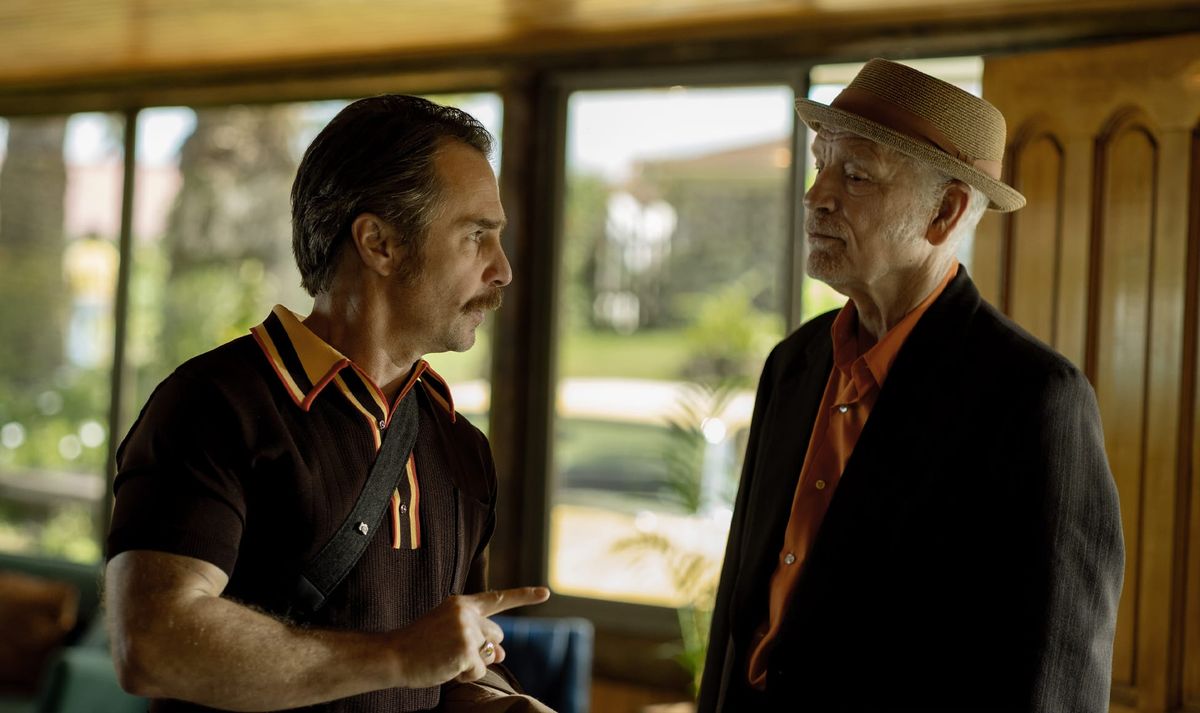
John Malkovich stars as Chris Carlisle, an ageing intelligence operative whose increasingly unpredictable behaviour threatens to expose the moral contradictions underlying his profession. Alongside him is Sam Rockwell's Lee Chesterfield, a longtime colleague whose apparent confidence and loyalty gradually reveal their own emotional complications. The two men are dispatched to Rapa Nui by their superior, MJ (Steve Buscemi), under circumstances that become increasingly suspicious as their assignment progresses. What initially resembles an unusual excursion to one of the world's most isolated inhabited islands gradually reveals itself as something considerably more complicated, particularly as Chris's deteriorating health begins testing the patience of his younger colleague.
Malkovich and Rockwell share exceptional chemistry, transforming even the most inconsequential conversations into entertaining demonstrations of McDonagh's distinctive dialogue. Malkovich is particularly compelling, balancing his character's eccentricities with an underlying vulnerability that becomes increasingly apparent, while Rockwell provides a wonderfully charismatic counterweight through his exasperated reactions and energetic delivery. Their relationship is defined by decades of shared experiences, mutual irritation, and an affection neither man seems particularly comfortable expressing. There is something wonderfully entertaining about watching two supposedly experienced intelligence operatives argue over matters of spectacular insignificance, especially when their professional responsibilities involve activities whose consequences extend far beyond their personal grievances.
Malkovich delivers one of the film's most memorable performances as a man whose intellectual curiosity, arrogance, and irreverence coexist with an increasingly uncomfortable awareness of his mortality. His unmistakable vocal cadence becomes an extraordinary comic instrument, particularly when Chris delivers observations of astonishing insensitivity with the composure of someone discussing an ordinary inconvenience. Yet beneath his eccentric personality lies a considerably more vulnerable individual, whose attempts to preserve his recollections suggest a growing preoccupation with the meaning of his existence. There is something profoundly ironic about a man whose professional life has depended upon concealing information suddenly becoming concerned with documenting his experiences, especially when those experiences involve activities that have contributed to political instability and human suffering.
Rockwell is equally impressive as Lee, whose impatience and comparatively practical disposition frequently make him the unwilling recipient of Chris's most outrageous observations. His expressions of disbelief and frustration possess exceptional comic precision, particularly when an apparently ordinary conversation becomes another opportunity for his colleague to demonstrate a complete disregard for discretion. Nevertheless, Lee's relationship with Chris gradually reveals an emotional complexity extending beyond their professional association, suggesting that years of shared experiences have created an attachment neither man is particularly capable of acknowledging. Their friendship is frequently dysfunctional, occasionally exhausting, and almost always entertaining, but the sincerity beneath their arguments becomes increasingly apparent as the narrative progresses.
McDonagh has always possessed an extraordinary ability to locate humour in humanity's darkest corners, and WILD HORSE NINE demonstrates that talent with remarkable consistency. His characters argue when they should listen, insult one another when they should apologise, and frequently respond to serious circumstances with an astonishing degree of stupidity. Yet their behaviour rarely feels entirely disconnected from reality, particularly when their outrageous conversations begin exposing insecurities neither character wishes to acknowledge. The film understands that humour and suffering are not mutually exclusive experiences, and that laughter can emerge from circumstances in which regret, fear, and melancholy are equally present. You will split your sides with laughter, but the film carries considerable emotional weight throughout its runtime without ever sacrificing its sense of fun.
Those familiar with IN BRUGES and THE BANSHEES OF INISHERIN will immediately recognise the director's distinctive sensibilities, particularly his fascination with morally compromised individuals whose relationships become complicated by guilt, resentment, and the possibility of permanent separation. McDonagh possesses a remarkable talent for constructing conversations that initially appear completely ridiculous before gradually revealing something profoundly uncomfortable about the people participating in them. His characters frequently communicate through insults and provocations, yet beneath their verbal hostility lies an almost desperate desire to be understood. WILD HORSE NINE continues this tradition with considerable confidence, transporting his familiar preoccupations with companionship and redemption to the distant shores of Polynesia.
The historical setting introduces another fascinating dimension, particularly through its examination of American intelligence operations during one of Chile's most consequential political periods. The approaching overthrow of Salvador Allende's democratically elected government provides an unsettling backdrop to the protagonists' seemingly ordinary professional concerns, exposing the extraordinary distance between geopolitical decision-making and its human consequences. McDonagh is especially effective at highlighting the casual indifference with which powerful institutions can approach the destabilisation of entire societies, often treating political interference as little more than an occupational responsibility. The resulting humour becomes increasingly uncomfortable, particularly when the characters' personal grievances appear almost absurdly insignificant beside the historical circumstances surrounding them.
On September 11, 1973, the Chilean armed forces overthrew Allende's government, bringing Augusto Pinochet to power and inaugurating a military dictatorship characterised by political repression, censorship, and systematic violations of human rights. American involvement in efforts to destabilise Allende's administration remains one of the most notorious episodes in the history of United States foreign policy toward Latin America. Although WILD HORSE NINE is a fictional narrative rather than a comprehensive historical reconstruction, its political foundations are unmistakable. There is something particularly disturbing about the contrast between the tranquillity of Rapa Nui and the catastrophe approaching mainland Chile, especially as Chris and Lee occupy themselves with their peculiar holiday while the country they have helped destabilise moves toward profound national trauma.
Nevertheless, WILD HORSE NINE is not a conventional political thriller, nor does it attempt to provide an exhaustive examination of the Chilean coup. Its historical circumstances instead establish the moral foundations of a more personal investigation into complicity, responsibility, and the possibility of redemption. Mariana di Girolamo and Ailín Salas, portraying Mónica and Alicia, introduce a welcome perspective that challenges the older men's professional cynicism and reminds audiences of the lives affected by political decisions made elsewhere. Their performances contribute substantially to the film's emotional and historical texture, although a more extensive exploration of Chilean experiences might have strengthened its political resonance.
One of the film's most affecting cultural dimensions emerges through its engagement with Chilean folk music, particularly the traditions associated with Nueva Canción Chilena and the extraordinary artists who helped shape the country's cultural identity. Víctor Jara occupies an especially significant place within this historical landscape, having become one of Chile's most influential singer-songwriters through his commitment to folk traditions, social justice, and the experiences of ordinary working people. His murder following the military coup remains an enduring symbol of the dictatorship's brutality and its determination to suppress artistic and political dissent. For anyone familiar with his music, the knowledge of what awaits Chile's cultural community lends an additional layer of sadness to the film's historical setting.
Violeta Parra's GRACIAS A LA VIDA provides an especially poignant reflection on the film's central concerns, with its expressions of gratitude and the contradictions of human experience resonating beautifully with McDonagh's exploration of mortality. Parra's extraordinary contribution to Chilean folk music extends far beyond the beauty of her compositions, representing a profound commitment to preserving cultural traditions and recognising the dignity of ordinary people. Her music offers a striking contrast to the elaborate cynicism through which Chris and Lee communicate their feelings, expressing grief, hope, and gratitude with a directness that their personal relationships rarely achieve. It is difficult to contemplate the beauty of such music without also recognising the political suffering that would subsequently become inseparable from Chile's collective memory.
Visually, WILD HORSE NINE is absolutely magnificent, with cinematographer Ben Davis capturing the extraordinary landscapes of Rapa Nui in breathtaking detail. Its windswept grasslands, volcanic terrain, rugged coastline, and monumental moai create an atmosphere of remarkable beauty and isolation, providing an almost spiritual contrast to the protagonists' increasingly complicated emotional circumstances. McDonagh has frequently employed isolated environments to expose the limitations of his characters, and the island serves a similarly compelling purpose here. Its cultural and historical significance extends far beyond the concerns of the visiting Americans, reminding audiences that the world possesses an enduring identity independent of the ambitions and failures of powerful individuals.
The moai are particularly striking, their silent presence offering a remarkable contrast to the incessant conversations and temporary concerns of the American protagonists. These monumental ancestral figures possess profound cultural significance for the Rapa Nui people, representing traditions and connections extending far beyond the comparatively brief historical moment in which McDonagh's narrative unfolds. There is an unmistakable irony in watching two representatives of American geopolitical influence wander through landscapes shaped by centuries of Polynesian history, apparently incapable of appreciating their surroundings without filtering them through their peculiar observations. The island's wild horses introduce another evocative element, their movement across the landscape suggesting a freedom that contrasts with the psychological confinement experienced by Chris and Lee.
The film's supporting ensemble further enriches its peculiar atmosphere, particularly Steve Buscemi as MJ, whose increasing exasperation provides some wonderfully entertaining exchanges. Parker Posey, appearing as Lee's wife Marge, brings additional personality to the narrative, while Tom Waits contributes his unmistakable presence as Chris's estranged brother. Carter Burwell's musical score enhances the quieter emotional passages without overwhelming them, providing a reflective accompaniment to the film's changing emotional register. Its period presentation is similarly accomplished, with the costumes, interiors, and visual textures establishing the early 1970s without becoming excessively preoccupied with nostalgic detail.
Perhaps the film's greatest achievement is its understanding of mortality and the uncomfortable realisation that time cannot be endlessly recovered. Chris's reflections on his past gradually become inseparable from his recognition that personal regret does not necessarily provide an opportunity for moral restoration. McDonagh wisely avoids transforming his characters into conveniently redeemed individuals, recognising that genuine remorse cannot erase the consequences of earlier decisions. Their capacity for tenderness exists alongside their capacity for extraordinary selfishness, creating an uncomfortable but convincing portrait of human contradiction. The film does not demand that audiences forgive its protagonists, but instead asks whether individuals can possess meaningful emotional lives without necessarily becoming admirable people.
Equally compelling is its exploration of friendship, particularly the difficulty of expressing affection within relationships shaped by years of emotional avoidance. Chris and Lee communicate through insults, ridiculous arguments, and familiar provocations, yet their exchanges gradually reveal a connection that extends beyond professional obligation. Their relationship is neither particularly healthy nor conventionally admirable, but it possesses the unmistakable familiarity of two people whose lives have become deeply intertwined. McDonagh understands that meaningful expressions of companionship do not always emerge through grand declarations, and that affection can exist within moments of irritation, silence, and shared vulnerability. As the film becomes increasingly conscious of mortality, these seemingly ordinary interactions acquire an unexpected emotional significance.
There is something particularly affecting about the film's refusal to separate the beauty of existence from its more unpleasant realities. Human beings make terrible decisions, damage relationships, pursue meaningless ambitions, and occasionally behave like complete idiots, yet they remain capable of extraordinary compassion, humour, and affection. McDonagh approaches these contradictions without offering simplistic reassurances, allowing moments of genuine tenderness to coexist with political cynicism and moral ambiguity. His characters are neither straightforward heroes nor uncomplicated villains, but deeply imperfect individuals whose humanity cannot be reduced to their most admirable or reprehensible qualities.
Admittedly, WILD HORSE NINE occasionally becomes indulgent in its own eccentricities, with certain conversations extending beyond their immediate dramatic necessity. McDonagh's dialogue is frequently brilliant, although his characters sometimes appear almost excessively conscious of their own wit, creating moments that feel more carefully constructed than spontaneous. The film's leisurely pacing may also frustrate viewers expecting a conventional espionage thriller, while its historical backdrop presents opportunities for a more substantial examination of Chilean experiences. Nevertheless, these limitations do relatively little to diminish the overall experience, especially when the screenplay's humour, emotional intelligence, and thematic ambitions are considered together.
What I particularly appreciated about WILD HORSE NINE was its ability to provoke genuine laughter while simultaneously encouraging reflection on the fragility of life. Malkovich and Rockwell are magnificent together, delivering performances that balance outrageous comedy with a surprisingly affecting examination of ageing, companionship, and regret. The extraordinary landscapes of Rapa Nui provide a beautiful contrast to the emotional burdens carried by their characters, emphasising the enduring significance of places and cultures beyond the comparatively insignificant concerns of individual human beings. Beneath the film's absurdity lies an unmistakable appreciation for the connections we form, the memories we accumulate, and the moments of beauty that persist despite our imperfections.
Ultimately, WILD HORSE NINE is a wonderfully irreverent, thoughtful, and emotionally rewarding work that demonstrates McDonagh's remarkable ability to balance comedy with genuine dramatic substance. Its political undertones, eccentric characters, breathtaking cinematography, and exceptional central performances contribute to a film considerably more substantial than its unusual premise might initially suggest. Although its narrative occasionally wanders and its historical perspective is not without limitations, the film's understanding of friendship, mortality, and moral complexity gives it a lasting emotional resonance. It recognises that life is rarely exclusively tragic or joyful, and that some of its most meaningful experiences emerge from the uncomfortable coexistence of both.
Above all, WILD HORSE NINE is a celebration of the profoundly fucked-up beauty of being alive, acknowledging the absurdity, melancholy, cruelty, compassion, and occasional magnificence that define the human experience. McDonagh has crafted a film that encourages audiences to laugh at humanity's extraordinary foolishness while recognising the emotional significance of our relationships and the inevitable passage of time. It is as entertaining as it is contemplative, as ridiculous as it is poignant, and as deeply imperfect as the individuals whose lives it examines. For all its profanity, political cynicism, and outrageous humour, the film ultimately leaves behind something surprisingly beautiful: an appreciation for life in all its contradictions, and a reminder that even amid uncertainty and regret, there remains an extraordinary amount worth celebrating.
Perhaps that is the greatest achievement of WILD HORSE NINE, a film that reminds us that existence can be simultaneously beautiful, ridiculous, heartbreaking, and profoundly unfair without losing its capacity to inspire wonder. Its characters have spent much of their lives influencing the destinies of others while remaining almost entirely incapable of understanding their own, yet their experiences reveal something recognisably human about our attempts to find meaning amid uncertainty. Against the magnificent landscapes of Rapa Nui, with the cultural resonance of Chilean folk music lending an additional measure of poignancy, McDonagh transforms an absurd holiday between two morally compromised intelligence operatives into something unexpectedly profound.
For all the cruelty, stupidity, political interference, and personal failures that define its narrative, WILD HORSE NINE ultimately reminds us that the world remains capable of producing extraordinary beauty, meaningful companionship, and moments of genuine tenderness. We laugh at the absurdity, mourn the tragedy, and marvel at the beauty, sometimes within the same conversation, while life continues beyond the limitations of our understanding. It is a sentiment that brings me back to Violeta Parra's extraordinary reflections on gratitude for an existence that contains an almost unbearable capacity for sorrow, and one that feels especially appropriate for a film so fascinated by the contradictions of being alive.