You can see everything. That’s why you lose.

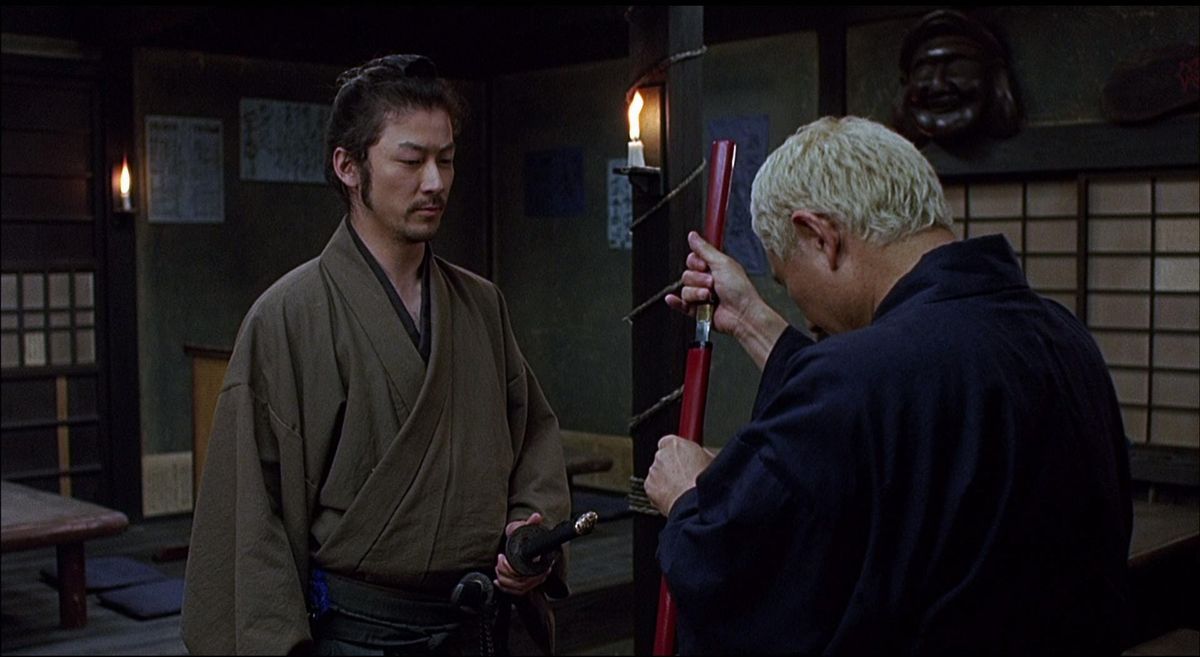
ZATOICHI isn’t a samurai film about violence. It’s about rhythm—how violence, labor, and performance fall into patterns, and how those patterns shape the way a world is understood. The sword is central, but not as spectacle. It’s part of a larger system of timing, repetition, and release.
Because Zatoichi doesn’t treat action as escalation. It treats it as punctuation. Scenes don’t build toward fights so much as circle them, letting tension accumulate in quieter spaces—gambling tables, rural roads, small gestures that carry an undercurrent of inevitability. When violence arrives, it lands quickly, almost abruptly, as if it were always waiting just beneath the surface rhythm.
Takeshi Kitano plays Zatoichi with a deliberate flatness that resists myth. There’s no overt mystique, no attempt to elevate the character into legend. He moves through the world casually, almost indifferently, and that indifference becomes its own kind of control. The performance doesn’t ask to be admired. It asks to be observed.
What’s striking is how the film distributes attention. The blind swordsman isn’t the sole center of gravity. Farmers, gamblers, performers—entire pockets of life are given space to exist on their own terms. The narrative threads don’t converge neatly. They overlap, drift, return. The film isn’t organizing the world around a hero. It’s letting the world move, and placing him within it.
Formally, that movement is everything. The editing has a musical logic—beats, pauses, sudden cuts that feel less like narrative decisions and more like rhythmic ones. Sound does as much work as image. Footsteps, rain, tools striking wood or earth—these aren’t background details. They create a cadence the film keeps returning to.
The setting isn’t romanticized. It’s textured, lived, often harsh. Labor is constant. Survival is routine. But the film doesn’t frame that as purely grim. It finds energy in repetition—in the way daily life produces its own rhythms. That’s where the film’s tonal shifts come from. Humor, violence, and stillness don’t clash. They share the same underlying beat.
Power operates less through hierarchy and more through control of space and tempo. The gang at the center exerts dominance not just through force, but through how they regulate movement—who can speak, who can act, when something is allowed to happen. Zatoichi disrupts that not by challenging authority directly, but by refusing to move in sync with it.
When violence unfolds, it’s stripped of ornament but heightened in impact. The choreography is precise, almost mechanical, but never indulgent. Blades move quickly, bodies fall, and the film moves on. There’s no lingering on consequence in a sentimental sense. Instead, the repetition of these moments builds a cumulative weight.
Ethically, the film stays ambiguous. It doesn’t moralize the violence, but it doesn’t neutralize it either. Revenge exists alongside survival, alongside routine. The film doesn’t separate these impulses cleanly. It lets them coexist, sometimes uncomfortably.
And then there’s the ending, which shifts everything without fully explaining itself. The tap sequence isn’t an add-on or a joke. It’s a formal extension of what the film has been doing all along—turning movement into rhythm, rhythm into meaning. Violence, labor, performance—they collapse into the same language.
That final gesture reframes what came before. ZATOICHI isn’t building toward catharsis. It’s building toward recognition—of pattern, of repetition, of the way a world holds together through shared timing even as it fractures.
What lingers isn’t the fights or even the character. It’s the cadence. A film that understands action not as spectacle, but as part of a larger rhythm—and trusts that rhythm to carry everything else.