Let there be beauty.

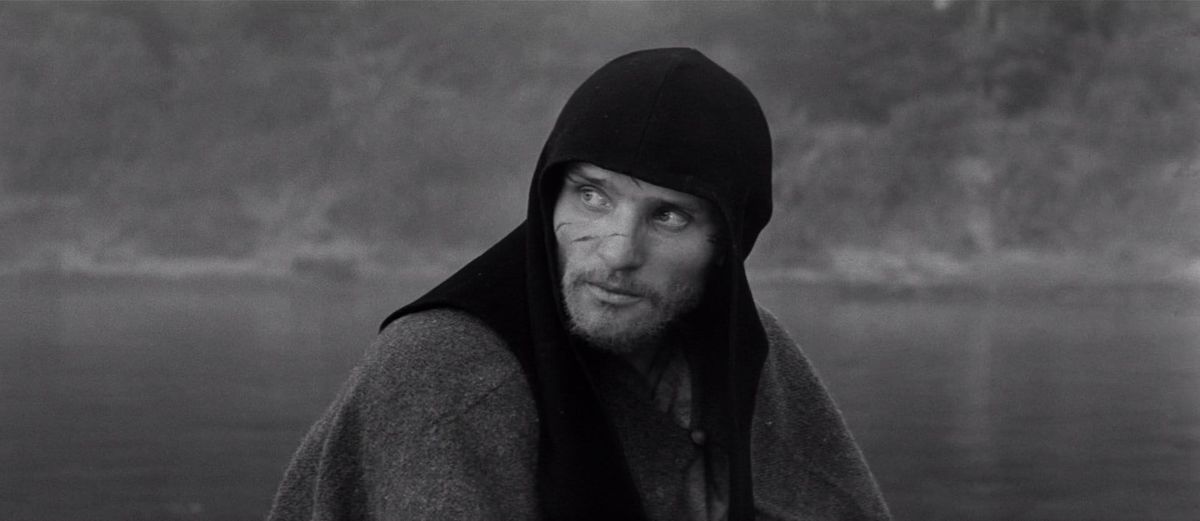
ANDREI RUBLEV is a profound meditation on art, faith, suffering, and the responsibility of creation in a world defined by uncertainty. Andrei Rublev is not simply a historical drama about a fifteenth-century icon painter, but a searching philosophical inquiry into the purpose of creativity itself. Andrei Tarkovsky transforms the life of Andrei Rublev into a timeless exploration of why humanity continues to create despite overwhelming darkness. Rather than celebrating genius through triumph, Tarkovsky portrays artistic achievement as something inseparable from pain, doubt, and moral responsibility.
The brilliance of the film comes from its understanding that art is never separated from the world around it. Rublev's silence, doubt, and spiritual struggle reflect the burden carried by anyone attempting to preserve beauty while surrounded by violence, cruelty, and despair. Every act of creation becomes an act of resistance against chaos, while every brushstroke carries the weight of a fractured society. Tarkovsky refuses to romanticize either suffering or inspiration, instead suggesting that genuine art emerges only after confronting humanity at its most broken.
Structured as a series of interconnected episodes rather than a conventional biography, the film allows centuries of Russian history to unfold through moments of extraordinary intimacy and devastation. Invasions, famine, political upheaval, betrayal, and religious conflict become less historical events than emotional landscapes through which Rublev must navigate. Tarkovsky's episodic approach creates the sensation of leafing through fragments of memory, where each chapter reveals another dimension of the artist's evolving understanding of faith, compassion, and forgiveness.
Anatoly Solonitsyn delivers one of cinema's great internal performances, capturing a man whose greatest conflicts occur almost entirely within his own conscience. Solonitsyn communicates immense emotional depth through restrained expressions, prolonged silences, and subtle shifts in posture, allowing viewers to witness a soul wrestling with impossible questions. His Rublev rarely dominates a scene through words, yet remains its emotional centre through sheer spiritual presence.
Around him, Tarkovsky assembles an unforgettable ensemble that gives medieval Russia remarkable humanity. Nikolai Grinko, Nikolai Burlyaev, Irma Raush and the supporting cast inhabit their characters with extraordinary naturalism, never feeling like figures preserved inside history books. Their performances ground Tarkovsky's philosophical ambitions in recognisably human fears, hopes, and contradictions.
Visually, the film stands among the greatest achievements ever committed to black-and-white cinematography. Vadim Yusov photographs landscapes drenched in rain, forests cloaked in mist, candlelit churches, and mud-soaked villages with astonishing tactile realism. Every frame possesses the texture of an ancient fresco brought to life, balancing breathtaking beauty with physical hardship. Tarkovsky's famously patient camera movements invite contemplation rather than spectacle, allowing time itself to become one of the film's central subjects.
The director's command of imagery borders on the transcendent. A horse collapsing beside a river, flames consuming sacred architecture, bodies drifting through water, and faces illuminated only by candlelight linger in the memory long after the film ends. These are not merely beautiful compositions but visual expressions of spiritual conflict, illustrating humanity's simultaneous capacity for destruction and grace. Few filmmakers have understood how an image alone can communicate ideas that dialogue never could.
Sound is treated with equal care. Extended passages of silence heighten every distant bell, gust of wind, hoofbeat, and whispered prayer, immersing the audience in a living medieval world rather than an idealised reconstruction. Music appears sparingly, making its emotional impact all the more profound when it finally arrives. Tarkovsky demonstrates extraordinary confidence in allowing atmosphere itself to carry meaning.
The famous bell-making sequence remains one of cinema's greatest reflections on creativity and belief. Young Boriska claims knowledge he may not possess, placing his life and reputation upon an act of faith rather than certainty. Watching him direct workers while privately consumed by terror becomes a breathtaking metaphor for every artist who continues creating despite never knowing whether inspiration will arrive. It is suspense built not around survival, but around the possibility that faith itself may prove enough.
That extraordinary finale also transforms Rublev's own spiritual journey. Witnessing another creator persevere through fear allows him to rediscover both compassion and purpose, reminding him that art does not require absolute certainty before it can exist. Instead, Tarkovsky argues that creation often begins precisely where certainty ends. The courage to continue despite doubt becomes the artist's greatest achievement.
The celebrated transition into colour during the closing sequence provides one of the most moving endings in cinema. After hours immersed in monochrome hardship, the vibrant icons attributed to Rublev appear with overwhelming emotional force. Tarkovsky reveals not only the destination of the artist's journey but the enduring legacy of human imagination itself. The paintings cease to function as museum pieces and instead become living testimonies to resilience, faith, and hope.
ANDREI RUBLEV endures because it understands the fragile relationship between artist and society. It recognises that beauty is neither an escape from suffering nor a denial of it, but a response to it. Few films have explored the responsibilities of creation with such spiritual depth, philosophical richness, and emotional honesty.
More than half a century after its release, Tarkovsky's masterpiece remains one of cinema's most moving examinations of why humanity continues to create, believe, and search for meaning even when the world offers every reason to surrender.