Where promises were forever broken.
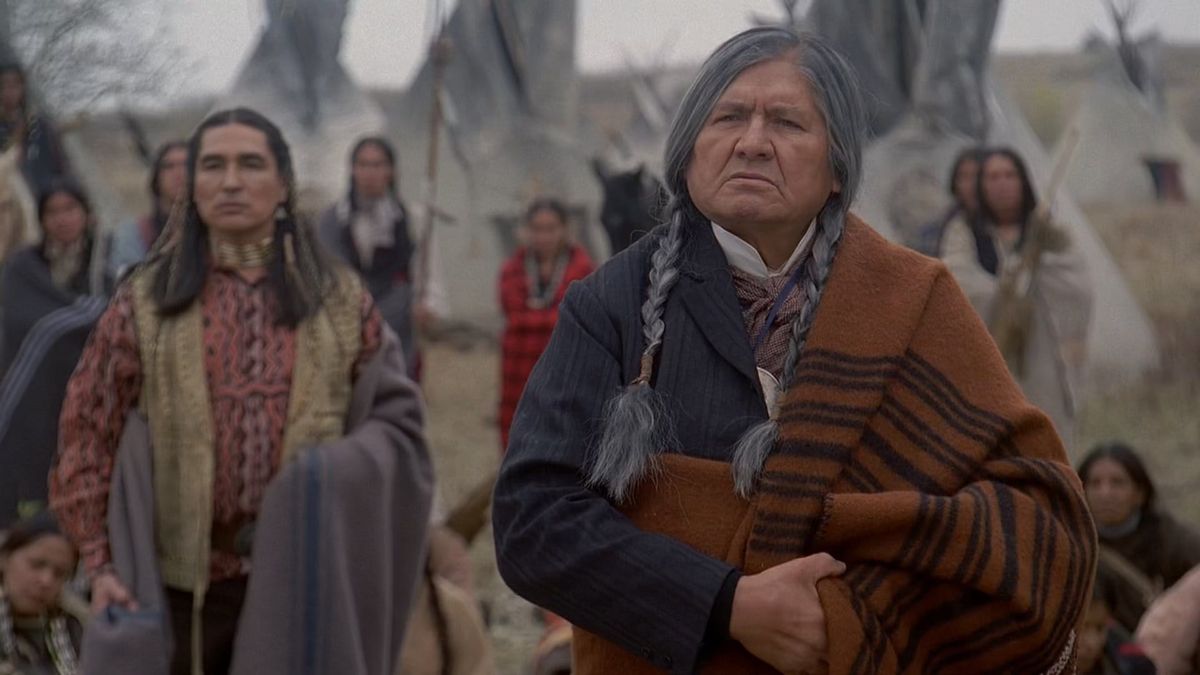
History is often remembered through the stories that are told the loudest. For generations, the experiences of Indigenous peoples during the westward expansion of the United States were too often pushed aside or filtered through someone else's perspective. BURY MY HEART AT WOUNDED KNEE chooses a different path. Rather than celebrating conquest, it asks audiences to witness the devastating human cost of it through the lives of the people who endured it.
Based on Dee Brown's landmark book and produced by HBO, the film spans the turbulent decades leading to the massacre at Wounded Knee in 1890. Director Yves Simoneau tells the story through several intersecting perspectives, balancing political decisions in Washington with the lives of Lakota communities fighting to preserve their land, culture, and identity. It is an ambitious historical drama that succeeds because it never loses sight of the people behind the history.
Adam Beach delivers one of the finest performances of his career as Charles Eastman. His portrayal is thoughtful, compassionate, and remarkably restrained. Eastman finds himself caught between two worlds, trying to serve his people while navigating institutions that rarely see them as equals. Beach never forces emotion. Instead, he lets every difficult decision quietly build upon the last, creating a character whose humanity anchors the entire film.
August Schellenberg is magnificent as Sitting Bull. His performance radiates dignity, wisdom, and unwavering conviction. Schellenberg understands that true authority rarely needs to be loud. Every glance and every measured word carries enormous weight, allowing Sitting Bull to emerge not simply as a legendary figure, but as a father, a leader, and a man witnessing the destruction of the world he has spent his life protecting.
Gordon Tootoosis brings remarkable depth to Chief Red Cloud. His portrayal reflects the impossible choices faced by leaders attempting to secure some future for their people under relentless political pressure. Tootoosis communicates years of experience, disappointment, and resilience without ever reducing Red Cloud to a historical footnote. His scenes add an emotional complexity that lingers long after they end.
Billy Merasty leaves a lasting impression as Young Man Afraid of His Horses. Although his role is smaller than some of the principal cast, Merasty fills every scene with authenticity and quiet emotional presence. He never feels like a supporting character simply serving the plot. Instead, he represents another voice within a community too often overlooked by history itself.
Wes Studi appears as Wovoka, the Paiute spiritual leader whose Ghost Dance movement became a source of hope for many Indigenous communities during an era of profound suffering. Studi has long been one of Indigenous cinema's defining actors, and even with limited screen time he brings warmth, sincerity, and quiet conviction to the role. His performance reminds audiences that hope itself can become an act of resistance.
The supporting cast deserves recognition as well. Eric Schweig, Eddie Spears, Morris Birdyellowhead, Duane Howard, and many others help create a world that feels lived in rather than reconstructed. Their performances ensure these communities are portrayed as people with families, beliefs, humour, grief, and resilience—not simply as names found in history books.
Visually, the film consistently impresses. The sweeping prairie landscapes are beautiful, but they also serve as a reminder of what was truly at stake. These were not empty frontiers waiting to be claimed. They were homelands filled with memory, tradition, ceremony, and generations of lived experience. David Franco's cinematography captures both the grandeur of the landscape and the intimacy of individual loss.
Yves Simoneau directs with admirable restraint. Violence is never glorified, and the film avoids turning tragedy into spectacle. Instead, the emotional impact comes from conversations, family relationships, and the growing realization that promises made to Indigenous nations continue to be broken. Those quieter moments often prove more devastating than the film's battles.
The screenplay also deserves praise for embracing complexity. It presents people who genuinely believe they are acting for the greater good alongside those who recognize the catastrophic consequences of government policy. That nuance makes the story stronger without diminishing the immense injustice experienced by Indigenous peoples.
No single film can fully capture the history that inspired it, nor should it be treated as the final word. What BURY MY HEART AT WOUNDED KNEE does exceptionally well is encourage audiences to learn more while placing Indigenous voices and experiences at the centre of its story. That choice gives the film both its emotional power and its lasting importance.
Nearly twenty years after its release, BURY MY HEART AT WOUNDED KNEE remains one of the finest historical television films ever produced. Led by outstanding performances from Adam Beach, August Schellenberg, Gordon Tootoosis, Billy Merasty, Wes Studi, and an exceptional Indigenous ensemble, it tells a profoundly difficult story with compassion, dignity, and respect.
It is not easy viewing, nor should it be. Some histories demand to be remembered exactly because they are uncomfortable.