Nobody asks what the sheep remember.

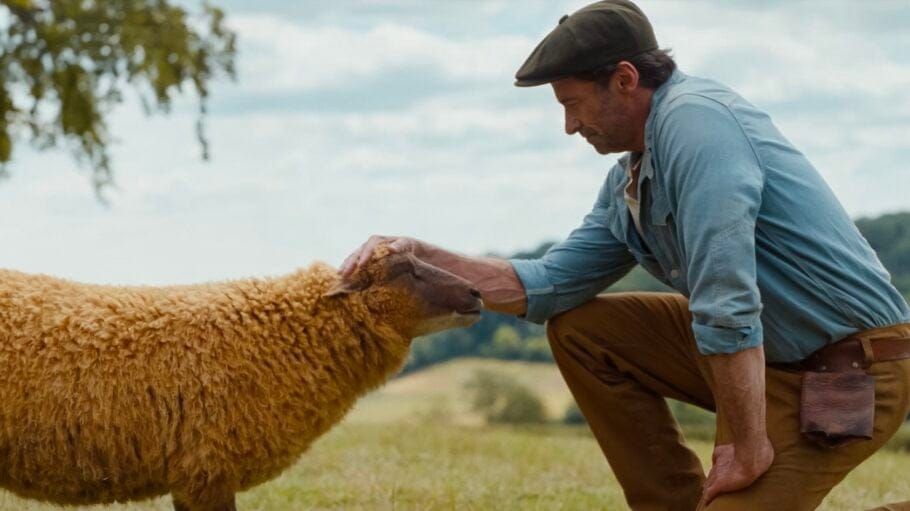
THE SHEEP DETECTIVES arrives disguised as one of those aggressively whimsical family films that practically dares you not to roll your eyes at the premise. Talking sheep. A cozy countryside murder. Hugh Jackman reading detective novels aloud to livestock. On paper, it sounds less like a film and more like the kind of fake movie poster you’d glimpse in the background of a sitcom.
But the film’s real trick is understanding exactly how absurd that setup sounds, then quietly using it to examine something much more human underneath: who society permits to observe, interpret, and matter.
This is not really a whodunnit in the traditional sense. The mystery itself is functional, sometimes intentionally simple, occasionally even secondary. What director Kyle Balda and writer Craig Mazin seem genuinely interested in is perception — specifically, the way intelligence and emotional awareness are dismissed when they come from voices deemed unserious.
The sheep are not treated as comic relief within their own world. The humans underestimate them because the humans have already decided what sheep are supposed to be: passive, interchangeable, incapable of interpretation. The film keeps returning to that imbalance of power, and that’s where it becomes unexpectedly compelling.
The premise follows George Hardy, a shepherd played by Hugh Jackman, who reads detective novels to his flock every evening under the assumption that they cannot possibly understand him. When George dies under suspicious circumstances, the sheep begin investigating the murder themselves, piecing together clues missed or ignored by the humans surrounding them. The setup carries shades of cozy British mystery fiction filtered through contemporary animated family storytelling, though the film is considerably sadder and more reflective than its marketing initially suggests.
What surprised me most is how restrained the film often is visually. Balda does not direct the countryside as fantasy postcard England. The fields feel muddy, damp, inhabited. Fences sag. Barns look weathered rather than curated for aesthetic charm. The setting matters because the film understands rural life as labor before it understands it as atmosphere.
That grounded sense of geography gives the emotional material more weight. The sheep are funny, yes, but they are also livestock. The film never fully forgets that uncomfortable fact, and it quietly changes how the audience reads certain scenes.
The animation work deserves particular credit for avoiding overexpression. The sheep are anthropomorphized emotionally, but not flattened into hyperactive cartoon mascots. Framestore’s effects preserve enough animal physicality that the flock still feels recognizably sheep-like in movement and behavior.
Their personalities emerge less through exaggerated design than through rhythm, hesitation, memory, and group dynamics. That choice matters because it preserves the film’s central tension: these animals are intelligent, but they still exist inside structures built entirely without their agency in mind.
That tension extends into the voice performances, which are consistently stronger than the screenplay’s more obvious punchlines. Julia Louis-Dreyfus gives Lily a measured confidence that keeps the character from becoming merely “the smart one,” while Bryan Cranston’s Sebastian introduces a bitterness and social alienation the film wisely refuses to smooth over.
Bella Ramsey, Patrick Stewart, Regina Hall, and Chris O’Dowd all understand the tonal assignment: sincerity first, comedy second. The film works because the cast never performs the material with embarrassment. Everyone commits fully to the emotional reality of sheep solving a murder, which paradoxically makes the premise easier to accept.
Hugh Jackman, meanwhile, gives one of the quietest performances of his career. George is not written as a saintly shepherd archetype. He is lonely, emotionally withdrawn, easier with animals than with people, and often frustratingly distant.
The film resists sentimentalizing him into a symbol of rural purity. Even after his death, the movie keeps revealing contradictions about him through fragmented memories and conflicting perspectives. That complexity is important because it prevents grief from becoming tidy. The sheep love George deeply, but the film allows love and partial understanding to coexist.
Craig Mazin’s screenplay occasionally pushes too hard toward family-friendly reassurance, particularly during scenes where exposition arrives disguised as emotional clarity. There are moments where the film nearly mistrusts its own melancholy and rushes to soften it with another joke or pun.
Some of the sheep humor lands beautifully because it emerges naturally from character. Other moments feel more calculated, as though the studio became nervous the audience might sit with sadness for too long. The tonal balancing act is impressive overall, but you can occasionally feel the commercial machinery underneath it.
Still, the film’s emotional intelligence consistently outweighs its weaker instincts. What THE SHEEP DETECTIVES understands better than most modern family films is that gentleness and seriousness are not opposites.
The movie is undeniably cozy, but it is not weightless. Beneath the wool puns and murder mystery mechanics sits a story about community memory — about what happens when overlooked voices begin recognizing their own capacity to interpret the world around them.
That idea becomes especially interesting when viewed through the film’s treatment of hierarchy. Humans hold institutional power throughout the story: police authority, property ownership, legal legitimacy. The sheep possess none of those things. What they have instead is collective observation. They survive because they listen carefully to one another. The film repeatedly frames intelligence not as individual genius but as shared attention, accumulated slowly through conversation and trust. That’s a surprisingly humane idea for a mainstream studio comedy built around talking livestock.
The ending wisely avoids triumphalism. THE SHEEP DETECTIVES does not pretend structural power suddenly disappears because the “right” mystery gets solved. The sheep are still sheep by the final frame. The imbalance remains intact. What changes instead is recognition — both their recognition of themselves and, to a smaller extent, the audience’s recognition of them. The resolution leans toward hope rather than victory, and that distinction matters. Hope acknowledges continuation. Victory implies completion. This film is smart enough to understand the difference.
More than anything, THE SHEEP DETECTIVES succeeds because it refuses to treat kindness as stupidity. In an era where family films often confuse irony for intelligence and noise for emotional momentum, Balda’s film takes a quieter route. It asks the audience to pay attention to softness, observation, and vulnerability without mocking those qualities. That restraint gives the film an unexpected emotional durability.
It may arrive wearing the fleece of a goofy studio crowd-pleaser, but underneath, THE SHEEP DETECTIVES is a film about attention itself: who receives it, who gets dismissed, and what becomes visible once we stop assuming we already know which voices matter.